

The ultimate guide to inclusive and accessible recruitment
Practical steps to make job adverts, applications and interviews accessible for everyone

When you Google “job interview tips” you get a whole load of advice, like:
talk assertively
never say “like” or “um”
use formal, professional language
look groomed and polished
avoid talking about anything “political” (like racism or sexism).
So… behave like a stereotypical middle-class, CisHet white man?
The problem with mainstream advice
Guidance like this makes sense.
It’s based on conventional hiring processes. It gives you a sense of what many employers look for. And who they think matters most.
These standards reinforce oppressive ideas of which candidates are deemed legitimate.
Traditional professionalism is a bias-making machine.
We need the freedom - the permission - to express our differences, rather than suppressing who we are to pass as Professionals™️.

We know our differences are valuable. We just need the freedom - the permission - to express them.
Inclusion is for everyone
Your recruitment process is one of the most important chances you have to communicate your culture effectively, and to show your values.
39% of people have turned down or decided not to pursue a job because of a perceived lack of inclusion at an organisation.
Hiring in a way that’s inclusive and accessible won’t “just” benefit Disabled people (though that should be enough reason to take action).
It will help everyone.
The adjustments in this post will help people who are tired, dyspraxic, exhausted, distracted, introverted, temporarily ill, chronically ill, Deaf/deaf, partially sighted, who prefer listening to information to reading it, and so on.
It’ll benefit your organisation, too.
If each role had an inclusive application/interview process, we’d likely see:
More folks apply for roles that have been historically closed off,
Wider ideas of what talent, potential and professionalism look like,
Genuine appetite for and love of difference.
Where can we start? Writing truly inclusive job adverts.
How do I write an inclusive job advert?
Let’s look at how to make your job adverts more inclusive and accessible by tweaking:
The language you use
The requirements you ask for
Formatting your advert
Where you list your advert
(How you talk about) your workplace culture
The application process
The way you interview people
By the end, you’ll be equipped to improve your hiring process for everyone.
P.S. I’ll close each section with a checklist. You can download them all here:
1. Tweaking your language
In this section, we’ll look at how you can make the job description more accessible and inclusive.
Get the job title right
There are some unusual job titles out there, like “brand evangelist” or “happiness hero”.
Sometimes these job titles are:
designed as a bit of fun,
trying to compensate for poor compensation,
covering for lack of recognition,
a substitute for fulfilling work.
Folks aren’t falling for it.
Unless fancy job titles are genuinely meaningful in your industry, I suggest you cut the crap.1
Many of the more unusual job titles are papering over unclear priorities, too.
Or trying to conceal the role’s low strategic importance.
For example:
Often, ED&I hires are tasked with impossibly huge transformations. They’re expected to make this change happen on their own. Their incentive? A jazzy job title.
(No, calling someone a rockstar won’t make your unachievable goals possible.)
Many of the more unusual job titles are papering over unclear priorities. Otherwise, they’re trying to conceal the role’s low strategic importance.
Is it a junior position?
Once you’re happy with the job title, don’t prefix it with “junior” unless appropriate.
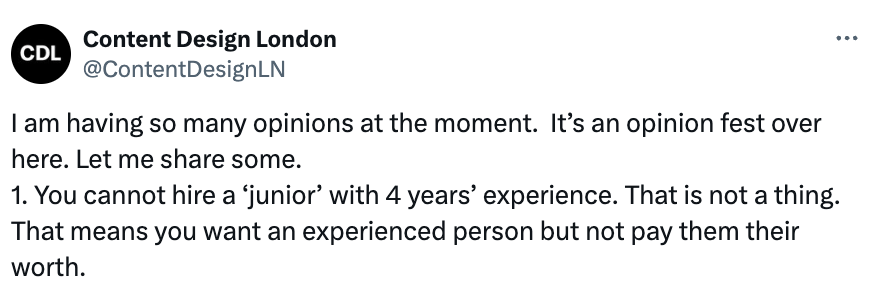
Don’t call the role “junior” if it requires years of experience.
Say the salary
Hiding the salary is a sneaky way for employers to underpay people.
It particularly harms women and racially minoritised folks.
One study found when employers were banned from asking for an applicant’s current or previous salary, pay increased:
for Black candidates by 13%
Pay gaps are also hideously common for Disabled people and the LGBTQIA+ community.
So, showing the salary is a simple ask that:
helps to address pay gaps for marginalised folks,
ensures everyone can access a fair wage,
will likely get you more applicants.
(Check out Show The Salary’s website for more reasons why this is important.)
Avoid jargon
Industry jargon (including buzzwords and acronyms) is boring.
It’s vague.
And it’ll only resonate with the few readers who have come across the terms before.
Inclusive job adverts are written to appeal to a bunch of different people. They seek out varied skills, experiences and perspectives.
Not only is jargon a communication barrier, but studies show jargon and inaccessible language are some of the top reasons young people won’t apply for entry-level jobs.
Crucially, jargon stops people from seeing themselves in your job advert - indicating they’re not welcome to apply.
Studies show jargon and inaccessible language are some of the top reasons young people won’t apply for entry-level jobs.

Free tools to help you drop the jargon
Unsuck It is a handy resource that shows you simple alternatives for dry business jargon like “synergy.”
Plain English also has a fantastic A to Z of alternative words.
Keep it simple
Making reading easier is…. actually pretty easy.
To make your job advert more digestible, try using:
short sentences - aim for 25 words or fewer,
everyday words,
headings and subheadings (to help people scan the page).
Structure your text for scanning.
To do that, put the important information up front.
Don’t say: “Please be sure to apply by 1 March”
Say: “Apply by 1 March”.

Use Hemingway Editor
The average reading level in the UK is entry level 3 (that used to be called a reading age of 9 to 11 years old).
An easy way to check your advert’s readability?
Use Hemingway Editor - a free, online tool.
Just copy and paste your advert into the text box, and it’ll highlight how to simplify it. You can also see the readability level - aim for grade 9 or below.
Watch out for coded language
Which job advert would you apply for:
a determined, assertive leader who’s capable of making tough decisions, or
a supportive and compassionate team player?
You probably have a strong preference. And your gender may be part of that.
Research suggests some words code as masculine, while others code as feminine.
Words that code as masculine include:
active
ambitious
assertive
competent
decisive
dominant
lead
objective
outspoken
self-confident
Words that code as feminine include:
cheerful
committed
interpersonal
nurturing
responsive
supportive
considerate
cooperative
compassionate
The impact of coded language
Women are 50% less likely to consider roles that have a coded gender bias, according to Be Applied.2
So, ask yourself:
What expectations are we encoding?
Who is traditionally associated with those qualities?
How can we focus on the concrete skill we need (rather than the types of people associated with that skill)?
5 free tools to spot and remove coded language:
Kat Matfield’s Gender Decoder highlights gendered words in job adverts.
Textio gives your job advert a diversity score and suggests improvements.
Joblint is designed for tech jobs and it flags a range of issues. For example, it noted that the phrase ‘hit the ground running’ suggests a recruiter isn’t aware of the time it takes to prepare a new team member.
Be Applied’s job description analysis tool decodes instances of gender bias.
Alex isn’t designed for job adverts, but it highlights inconsiderate language. It integrates with Slack, and other programs, suggesting alternatives for gendered, racist or otherwise harmful language.
Gender coding: beyond words
Swapping an overtly coded word for a more subtly coded word won’t work.
Because if you replace “competitive” with “love to win” or “committed to outstripping your peers”, then you’ve only changed the word - not the meaning.
And the meaning matters more than the specific words used.
Plus, simply throwing feminine-coded words into your job advert won’t make your entire recruitment process inclusive.
(For example, you could still evaluate candidates for gender-stereotypical features like warmth, which harms women who don’t fit the conventions of feminine niceness.)
Swapping an overtly coded word for a more subtly coded word won’t work.
Use singular “they”
Watch the pronouns you use in your job adverts.
Instead of saying “s/he will report to the head of the team who will manage him/her”
Try saying “they will report to the head of the team who will manage them”
In other words, stick to the singular “they” instead.3 Or “the successful candidate” or “the manager/officer/supervisor” will do.
Why does this matter? Not only is the jangling heap of pronouns in “s/he” messy, but it also excludes people who don’t use the pronouns “she” or “he”.
That means non-binary, gender fluid, genderqueer and other folks can’t see themselves in your job advert.

Not only is the jangling heap of pronouns in “s/he” messy, but it also excludes people who don’t use the pronouns “she” or “he”. That means non-binary, gender fluid, genderqueer and other folks can’t see themselves in your job advert.
Avoid euphemisms
Let’s look at some common euphemisms and the confusion they can cause.4
Fast-paced
“Fast paced-environment is often used as a euphemism for vague strategy and a lack of good leadership. It can too often mean chaotic management styles with thrashy, multiple-stakeholder miscommunication and, in-the-end, higher levels of stress.” - Hannah Ray.
If the pace of work is significantly faster than comparable organisations in your sector, why not get specific?
For example, you could:
explain that you serve 15% more deals than other companies of your size
show how you take steps to prevent that stress from passing on to your team.

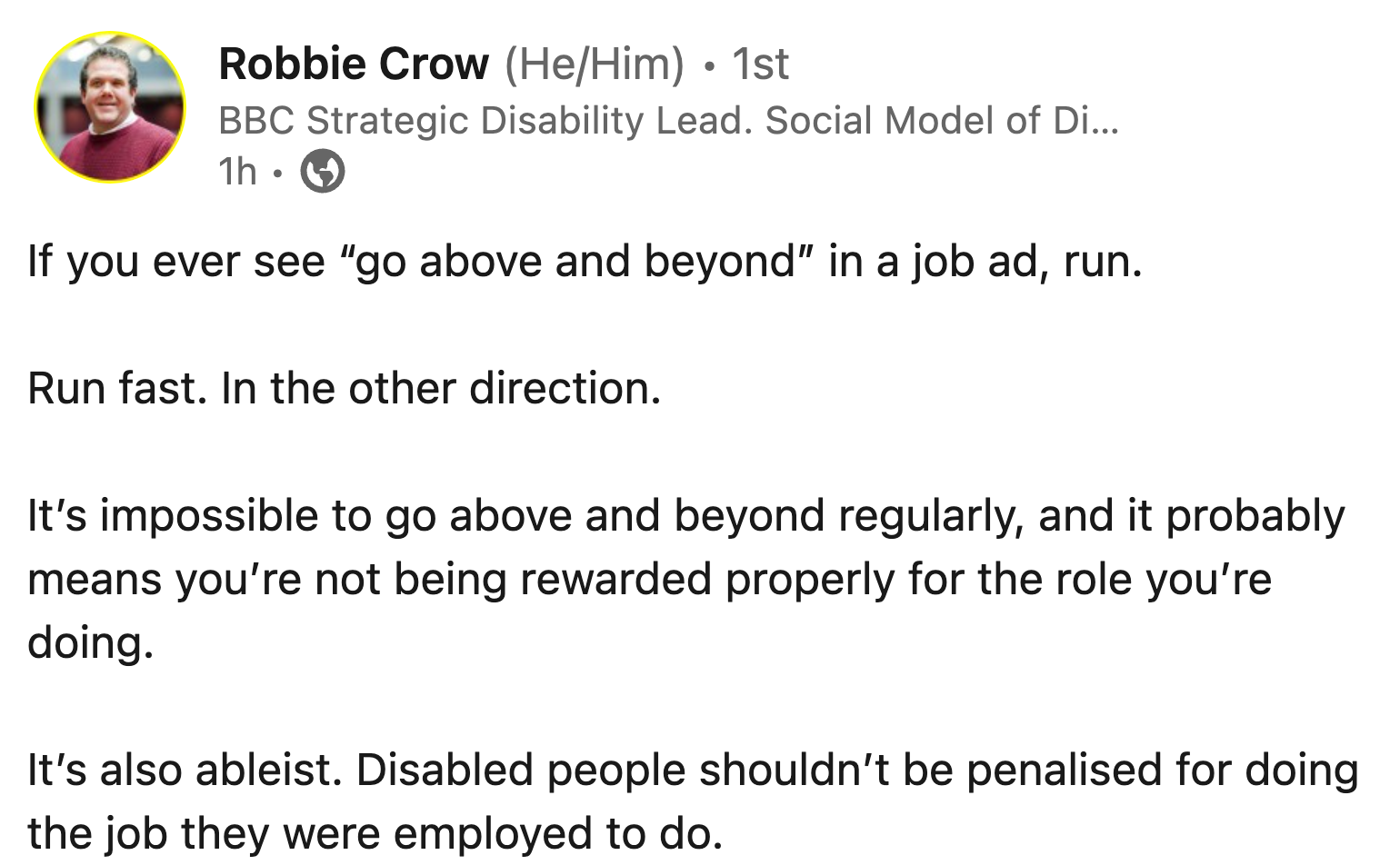
Must give 110%
Drop the productivity hyperbole (“we all give 110%, 400% of the time, 700 days a year”). Do your team ever rest?
Customer-obsessed
If your company is actually customer-obsessed, then go beyond the jargon.
Give specific, concrete examples of:
what you do,
how you do it, and
why you’re still able to provide a healthy working environment for your team.
“All the worst companies I’ve worked for described themselves as customer-obsessed. It can be used as a cover for seriously exploitative management practices.” - Software Engineer, Nisha.
Join the family
On the surface, this might seem lovely.
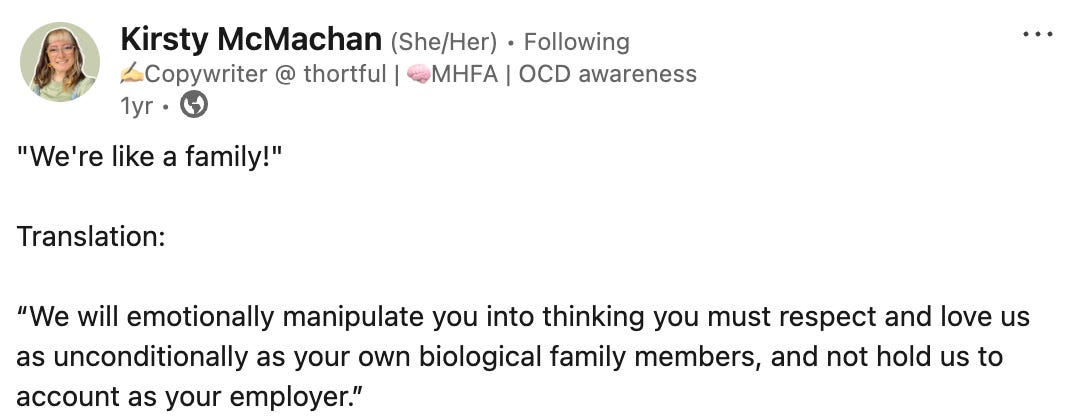
But if you dig a little deeper, it sounds as though your company has no boundaries. And it also implies that nobody… ever… leaves.
Calling it a family = a demand for emotional labour.
A healthier metaphor? A workplace should be a community, not a family.
Rockstars, superstars, and so on…
I’m sorry to break it to you, but calling your staff “rockstars” won’t make up for poor working conditions.
Likewise, “ninjas” sounds like Silicon Valley tech bro (*ahem*, did you read the section on coded language?).
And “guru” isn’t only inaccurate, it can also be as cultural appropriation.
Get. Specific.
Work hard, play hard
Did you mean: can you exploit yourself with minimal supervision?
This could be a fun way of dressing up exploitative working norms. The same goes for “must work well under pressure”.
Side note: here’s a super interesting podcast about not loving your job:
Proactive self-starter
What, new employees will just be left to their own devices? I’d expect to be powered by fear and adrenaline in my first few months (at least).
Phrases like this could put applicants off from fear of lack of support.
Weirdos welcome
Um, I don’t know about this one. (Big Dominic Cummings Energy, which I find alarming).
If you welcome behaviour way outside the norm of professionalism, that’s wonderful.
But spell it out. How? Why?
And link that “weirdness” with the skills required on the job, so people know you’re genuine.
Be literal
By now, you’ve probably spotted the same tip a fair few times: be specific.
Alongside this - and the “avoid euphemisms” tip - is another way to make your language inclusive:
Be literal.
Native English speakers and neurotypical people are likely to feel comfortable with phrases like:
“go the extra mile”
“learn the ropes”
“build a business from the ground up”
“get up to speed”
“protect the bottom line”
“think outside the box”
“wear many hats”
“bring added value to the table”
But if you don’t know, you don’t know.
Idioms (like those above) consolidate in-group status. Just like jargon, they only make sense if you already know them.
So, they can create unnecessary confusion for:
folks who are new to the industry
those who speak English as an additional language
neurodivergent people.
Idioms: the bigger picture
Sure, jokes and idioms might not seem like a big deal.
Yet they are part of a much larger problem: the systemic exclusion of neurodivergent people.
ADHDers are 60% more likely to be fired
ADHDers are 30% more likely to have ongoing employment issues
22% of autistic adults are in any kind of employment.
Note: of course, you can tell jokes and use idioms in conversation! Just explain them.
Welcome people, and be specific
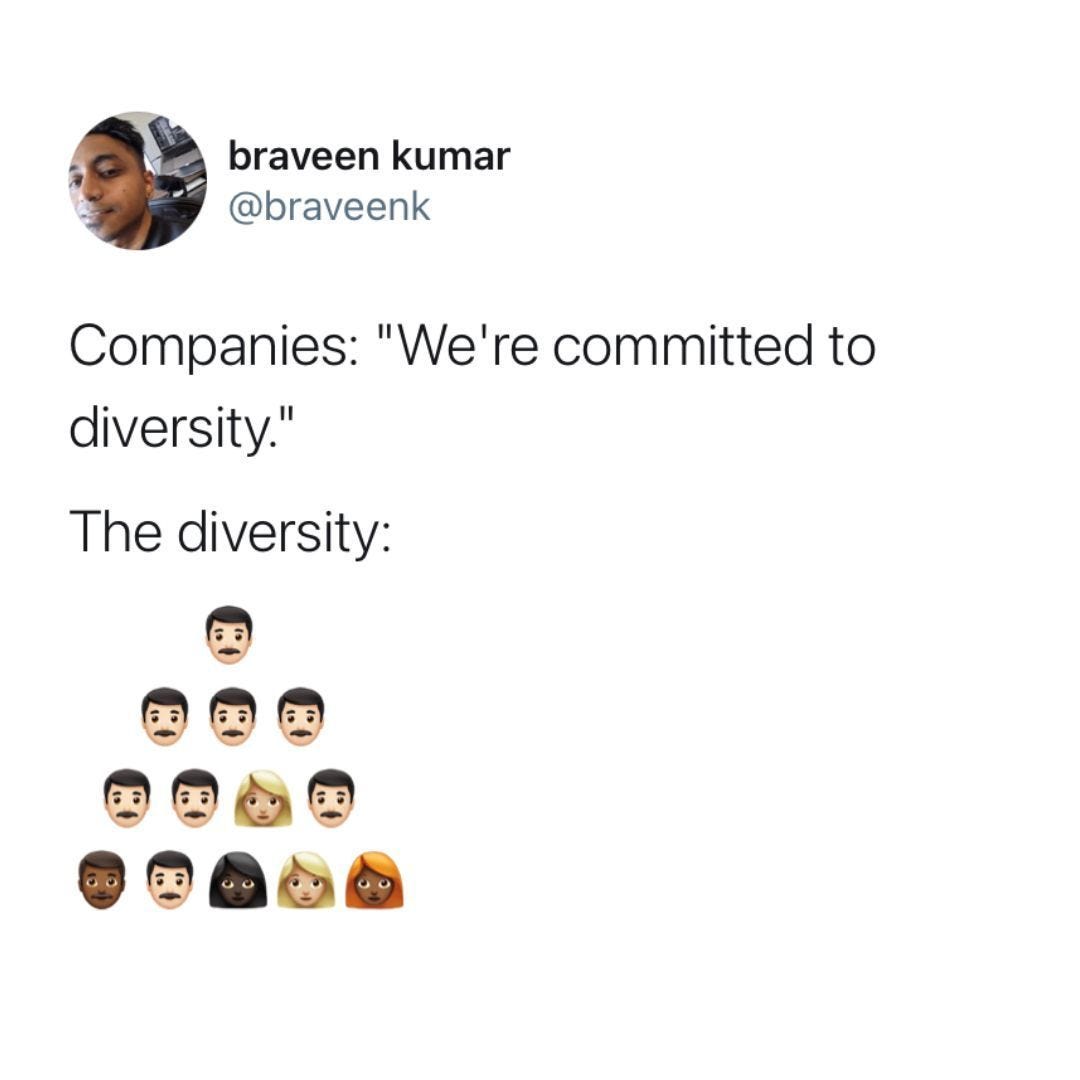
Don’t just say you’re looking for diverse applicants. Say who you’re looking for.
Are you welcoming applicants with convictions? Do you want to hire neurodivergent people and gender-diverse folks?
Lily Zheng shared a fantastic post about this. Here’s what Lily said (slightly edited for conciseness):
"This role is hoping to hire diverse candidates."
Are you targeting women? People of colour? Disabled folks? LGBTQ+ people? Immigrants?
"This role is hoping to hire people of colour."
Okay, so Indigenous folks? Black people? Mixed folks? Members of the Asian diaspora?
Communicate. Clearly.
If you’re committed to enriching your team, think about the perspectives you’re missing out on.
Your list won’t be exhaustive, and it doesn’t mean you’re only going to hire someone if they fit a few of those identities.
“I’m the only person of colour at a small heritage charity. When I looked at the website I saw a gallery of faces that don’t look like mine. But when I was applying for my job, they kept mentioning how they want to welcome different people in.
They named a whole load of identities they’d like to see more of, including people who are care-experienced and have experience of seeking asylum. I’m both of those things. I didn’t actually disclose in my interview because I don’t want to be pigeon-holed.
But they did say it at every stage, and it helped - but only because it came alongside their genuine willignness to adjust the application process so that the timings, locations and process worked better for me- to make me feel a little bit more like I was allowed to be there.” - Sam.5
A welcome message won’t address the deeper reasons that some people are excluded from employment, and it shouldn’t be mistaken for a structural fix.
Sam experienced a lot of harm in that job, so it wasn’t all joyful.
But a meaningful welcome statement can help people understand you’re doing the deeper work, if it’s paired with real evidence.
A welcome message (…) shouldn’t be mistaken for a structural fix. But a meaningful welcome statement is a light touch you can add on top of doing the deeper work.
No woke-washing
Watch yourself as you’re writing about your organisation. Resist the urge to make your team sound perfect.
“If greenwashing is hiding behind false eco credentials, woke-washing is pretending to be progressive.
Obviously it's a good thing if employers are more intentional with how they use language, so they're not unwittingly creating barriers or biases.
But 'inclusive writing' shouldn't be seen as a quick 'hack' to make yourself look better. That's just straight-up dishonest. And if you change your writing but not your culture, you won't fool people for long anyway.” - Nick Parker.
If you find yourself peppering your advert with adjectives like diverse, inclusive, progressive or equitable… think about your motivations.
Are you trying to make it seem inclusive without doing the deeper work?
If so, just say what’s imperfect (there will be plenty of things). Then say what you’re doing to change them.
Inviting minoritised candidates into an unsafe workplace is less inclusive, not more.
Inviting minoritised candidates into an unsafe workplace is less inclusive, not more.
Don’t just tell us about your commitment, show it
In other words, put your diversity statement out front.
A work report from LGBTQ+ charity Stonewall said employers should include “statements and examples of their commitment to LGBT staff, equality and inclusion” on their website as part of their efforts to be an inclusive workplace.
Equally, it’s important to communicate “a commitment to diversity and inclusion” in vacancy adverts.
Be punchy, authentic, genuine, human.
No copy-paste statements - that signals you don’t actually care about ED&I.
Avoid “we’re legally required to…” - it implies you’re only respecting their humanity out of legal obligation, not because you want to.
Fearless Futures are experts at this:
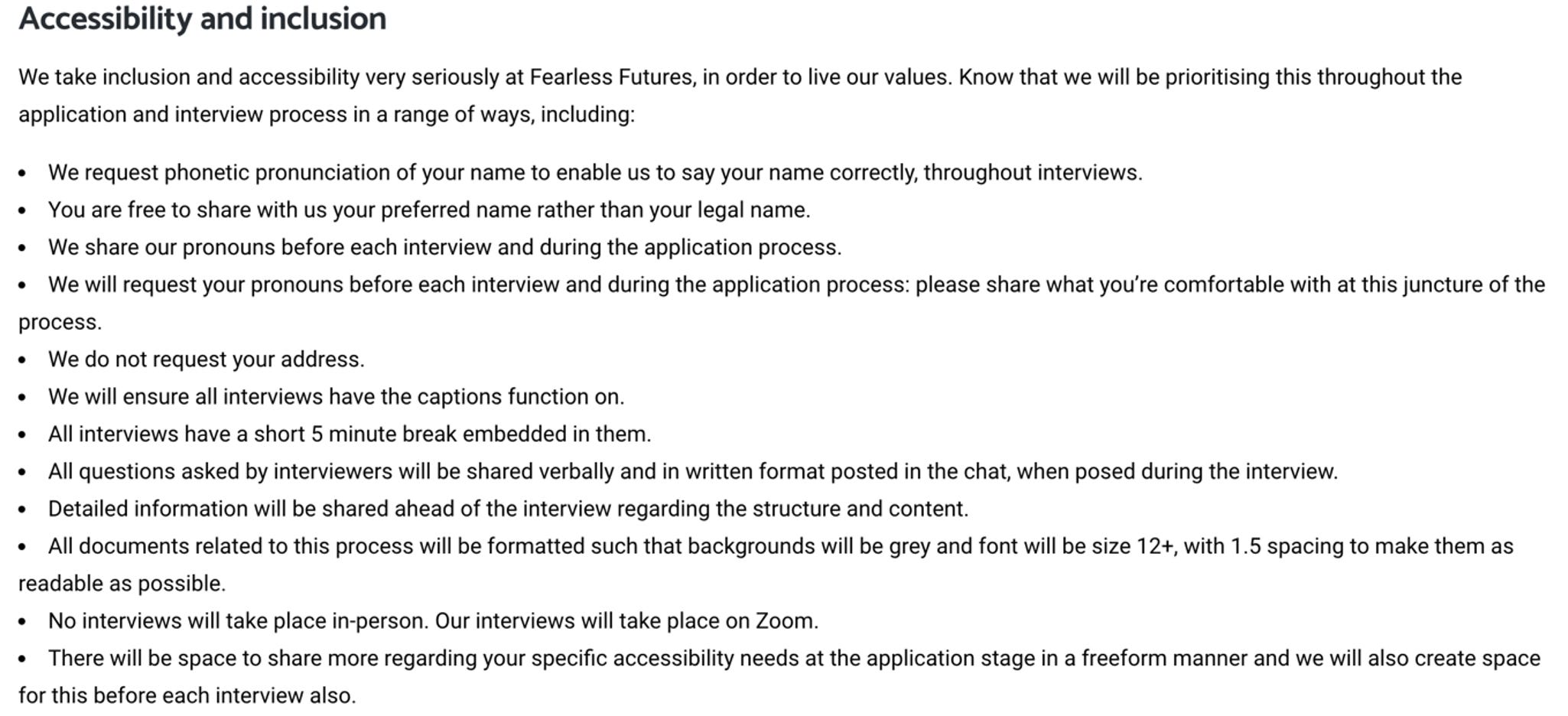
If you’re legally required to include some text about discrimination, then of course you have to say it.
In the USA, you often see lists like this one: “we do not discriminate on the basis of race, color, religion, sex (including pregnancy and gender identity), national origin, political affiliation, sexual orientation, marital status, disability, genetic information, age, membership in an employee organization, retaliation, parental status, military service or other non-merit factors.”
But don’t mistake statements like this for authentic and convincing expressions of inclusion.
A copy/paste list of identities and attributes isn’t convincing. These often read as lazy Google searches for everyone we’re meant to protect. It only works if it’s thoughtful.
Sonder & Tell do this brilliantly. Here’s how they frame the long list of diversity features as something specific, meaningful and genuine:
“We named our company Sonder & Tell after the made-up word ‘sonder’ which means that everyone has their own story; their own unique way of seeing the world. We value inclusive storytelling and are committed to diversity and inclusion. Not just because it’s the right thing to do but because it makes for richer stories.
As such, it is Sonder & Tell’s policy to treat employees, clients, all job applicants, colleagues and suppliers fairly and equally, regardless of actual or perceived age, sex, race, colour, nationality, national or ethnic origins, religion or belief, pregnancy, trans-gender status,6 sexual orientation, marital status, civil partnership status or disability.”
Do you see how this frames inclusion more meaningfully?
“Instead of showing me your diversity statement, show me your hiring data, your discrimination claim stats, your salary tables, your retention numbers, your diversity policies, and your leaders’ public actions against racism. End performative allyship.” - Monica Cox
Be concrete
Saying “we value diversity” sounds nice, but what does it mean?
This goes back to being specific. (Surprise.)
Because, often, we’re tempted to stick a label on things. We call them inclusive, progressive or kind; we have a vague sense that there’s something good about them.
Inclusion asks us to pause and look deeper:
What do you really mean by that?
Is it true of your workplace now, or is it a goal you aspire to? (That’s fine, just be honest that you’re on that journey.)
What’s the most concrete way you can show that trait?
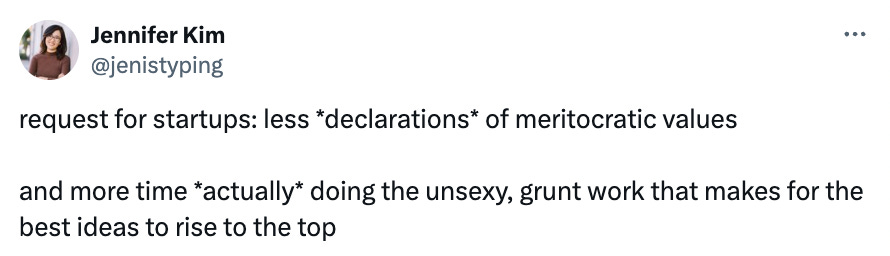
When it comes to values, show, don’t tell.
If you know who speaks matters (so your team uses amplification as one of your strategies to make sure minoritised folks get heard) then say it.
If you’re strict about making sure staff always get their evenings and weekends (to help everyone with mental health, many Disabled people with their physical health, women who typically have 60% more unpaid work than men, and women from racially minoritised groups who have even more unpaid work), then say it.
“Tell me you won't be texting me on my days off. Tell me you have an equitable relationship with your clients, where you know how to say no.
Tell me if my boss will actually have time to raise their children. If they won't, don't even come near me.” - Kathryn Izquierdo-Gallegos.
And be honest
No one’s perfect, so don’t pretend to be.
Is your workforce predominantly white, with a relatively even gender ratio, and skewing toward the 40-65 age range, with low visibility of Disabled and LGBTQ+ folks? Say that.
Is your workforce segmented into mostly white and East Asian knowledge workers who skew male and in their 20s-30s, and mostly Black and brown warehouse or factory workers of all genders and ages? Say that.
Is your workforce racially representative for your region, with a known population of Disabled and LGBTQ+ folks, and workers of all ages, but lacks the Indigenous and Black representation it needs to serve a national customer population? Say that.
No one’s perfect, so don’t pretend to be.
“So many of us are so afraid of saying something discriminatory or offensive that we're not even letting ourselves describe reality. Just say it! Say the phrase ‘white man,’ breathe for a second, and notice that nothing bad or good happened. Say the phrase ‘Disabled woman,’ breathe for a second, and notice that nothing bad or good happened.
Difference is a fact of our world. Inequality is a fact of our world. Until we can name these facts clearly and specifically, without judgment or fear, we'll be spinning our wheels uselessly without fixing a thing.” - Lily Zheng
Chayn do an amazing job of being transparent with candidates. Of genuinely answering, “What’s it like to work where you work?”
Read Chayn’s What it’s like to work here document. It’s brilliant.
Show your diversity data
Many job seekers want to see your diversity data. Publishing it can be good, but it’s even better if you explain it.
It’s better still if you can link it to your action plans.
Can you link the data to policies or evidence that shows you’re on the way?
How has your gender pay gap decreased?
How has the composition of your board changed in the last few years?
Can you point to staff survey data that shows things are improving?
Not all of that information will go into the job advert, but some of it may. And the rest will be valuable when you’re telling candidates more about your culture.
Describe the job accurately
Top tip: create a realistic job preview. This shows not only the good but the bad, too. No sugarcoating it.
It’s a great self-evaluation tool for folks to:
take a peek at the position,
decide whether it’s a good fit for them.
Vervoe’s guide to realistic job previews tells you how to make one!
State relevant benefits
Don’t sell legal rights as benefits; everyone’s entitled to the legal minimum days of annual leave.
A company email address is a basic right, not a perk. (Yes, I’ve genuinely seen this listed as a benefit).
If you do have Silicon Valley-style benefits like beer and ping-pong tables, that’s nice. But no one’s mistaking that for a genuinely inclusive culture.
(We’ll dive into this more in section 5 on “culture”.)
Work with the groups you’re trying to reach
Every organisation will have different aims.
If you have great Disability inclusion but terrible class inclusion, use that information.
If you’ve got a good representation of South Asian folks, but you lack nationwide diversity, then this should guide your choices.
“Collaborate or co-design the job ad with the specific group you are trying to work with. There are some great guidelines out there to support this type of stuff, but as language and its impact are constantly changing it's worth getting people in the room with senior management, paying for their time and asking them what works for them.” - Emily Horton
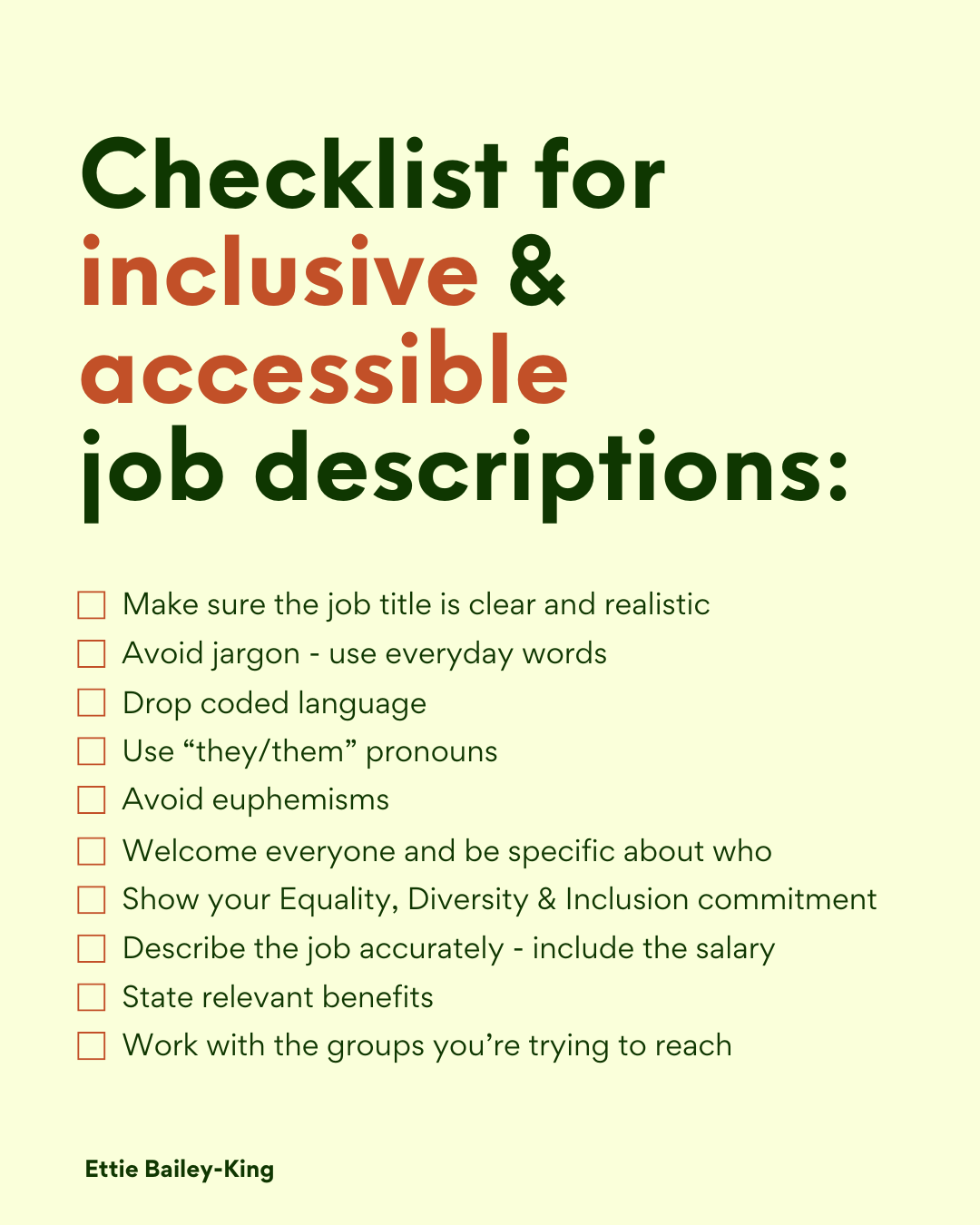
Section 1 checklist
2. The role requirements
In section two, we’ll cover tips to make job requirements accessible and inclusive.
Stick to must-haves
When it comes to requirements, only include the essentials.
When job responsibilities are clear, you won’t need two lists of “essential” and “desirable” attributes.
If the desirable attributes matter, then they are genuine requirements. If they’re not genuine requirements, don’t list them.
If the desirable attributes matter, then they are genuine requirements. If they’re not genuine requirements, don’t list them.
Why? Including lots of nice-to-haves will put some people off from applying, particularly women.
“78% of women’s reasons for not applying have to do with believing that the job qualifications are real requirements, and seeing the hiring process as more by-the-book and true to the on paper guidelines than it really is.” - Harvard Business Review
Define the skill, not the person
Instead of asking for a:
“Native English speaker”
“Graduate from a top university”
“Tech savvy” or “digital native”
“Brilliant speaker” or “confident presenter”
You could ask for:
“Someone who writes concise copy and adapts to different tones of voice”
“An analytical and original thinker”
“The ability to code in Python, with a basic Javascript and CSS understanding”
“Someone who can facilitate engaging workshops.”
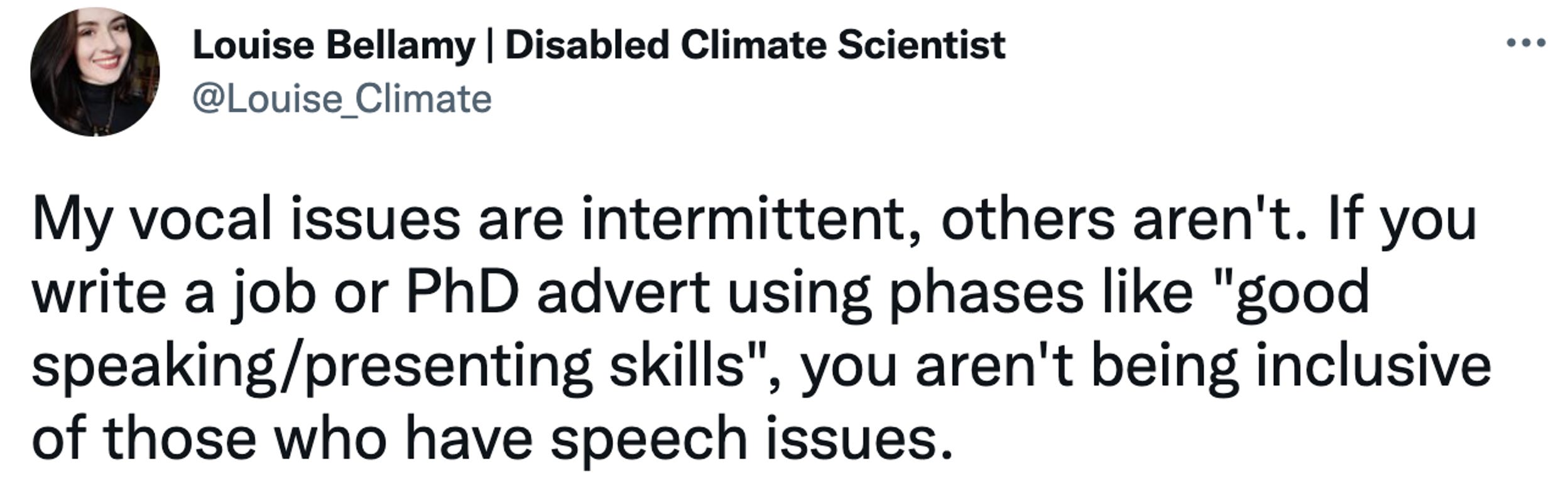
There’s no way you need to be a native English speaker to communicate effectively. A university degree is no guarantee of intellectual rigour. No one knows what “tech savvy” means. And asking for a “brilliant speaker” can exclude people with speech issues, like stammers.
Get clear on the essentials.
P.S. This can include what you don’t require: “We don’t ask for sick days records because that’s ableist and tends to harm women and people with caring responsibilities.”
There’s no way you need to be a native English speaker to communicate effectively. A university degree is no guarantee of intellectual rigour. No one knows what “tech savvy” means. And asking for a “brilliant speaker” can exclude people with speech issues, like stammers.
Don’t be generic
Be clear and specific about the skills/requirements.
That means avoiding vague phrases like “communication skills” or “work ethic”, which can put qualified applicants off applying.
(They might think “great communication skills” means “good at public speaking” when you actually meant “good at writing concisely.”)
This applies to responsibilities, too.
Rather than “manage social media”, list the key responsibilities. For example, content creation, copywriting, replying to comments/messages, and so on.
You could even specify concrete goals like: “Increase following on Instagram.”
Welcome transferrable skills
This is a simple, surefire way to get more applications from marginalised groups.
Let’s take a look at a couple of prime examples:
"We recognize that everyone brings skills and experiences to the table and that not everyone ‘checks all the boxes’. Apply anyway! Tell us why you’re the right fit for the job." - Government of Canada
“Experience comes in many forms, many skills are transferable, and passion goes a long way. If your experience is this close to what we’re looking for, consider applying. We know that diversity of thought makes for the best problem-solving and creative thinking, which is why we're dedicated to adding new perspectives to the team and encouraging everyone to apply.” - Shopify
Why does this make a job advert more inclusive?
By welcoming transferrable skills, you’ll also welcome those with imposter syndrome. Those who wouldn’t otherwise apply for your role.
But let’s be clear: imposter syndrome isn’t an individual experience of shyness or doubting yourself. Imposter syndrome is the product of systemic discrimination. We won’t fix it by asking individuals to “be more confident.”
We can help encourage people to apply by showing that, even if they’re from a background that hasn’t traditionally been welcomed or supported, they are wanted. And they will be given a wide variety of ways to engage. And they will be judged fairly.
“[I] always write a welcome letter. In it I emphasise that we want to hear from candidates who may have different backgrounds and believe they have transferable skills relevant to the post.” - Daniel Brine, Director of Norfolk & Norwich Festival.
Match job requirements to the role’s responsibilities
Requirements must match responsibilities.
Responsibilities are the tasks you need to do to succeed in a job.
Requirements are what you need to perform those responsibilities. (That might include specific qualifications, knowledge or experience.)
Requiring people to have degrees from Russell Group universities doesn’t match any responsibilities.
But if a candidate is responsible for running payroll, you can require the relevant training or experience needed to hire someone who knows how to run payroll.
Matching requirements to responsibilities will help you avoid including irrelevant requirements. (Unless it’s a driving role, does the applicant need a full license?)
Don’t require a degree
Access to university isn’t a level playing field.
Asking for a degree (especially a degree from a “top” university) will exclude countless qualified candidates.
In fact, asking for a degree may even fit the legal definition of discrimination.
Hire for potential
Recruit for potential, not perfection.
If you just hire people who can already do something, you may be playing to entrenched bias.
Because some people get offered more opportunities, and others find it harder to break through.
This is part of ACEVO’s eight principles (I love them).

ACEVO’s 8 principles are part of the Racial Diversity in the Charity Sector report, created in collaboration with the Institute of Fundraising.
If you just hire people who can already do something, you may be playing to entrenched bias. Because some people get offered more opportunities, and others find it harder to break through.
Look beyond years of experience
You might think listing the required years of experience is necessary. It isn’t always.
(It’s one of the weakest predictors of how ready someone is for the role.)
The more accurate way to hire a great fit? Assess people’s specific skills and competencies.
Sure, it takes longer to assess people’s skills. It’s worth it though, because:
You’ll find out what your applicants can actually do.
You’ll save yourself the disappointment of hiring someone who interviews like a dream but isn’t the skilled strategist/gifted writer they described themselves as being.
You’ll open up your role to bright, younger applicants.
Length of time in role doesn’t equal ability.
Length of time in role doesn’t equal ability.
Don’t ask for people who’ve done the job before
Do you need someone who’s done this exact role before?
Or do you need someone who has the skills and knowledge to be able to do the role?
(There’s a difference.)
Asking for previous experience excludes everyone who’s ever been told “I just can’t see you as a leader/manager/head of team.”
In other words, many minoritised folks.
Their reference? Their preference
Do you need references for 3, 5 or 10 years? Do you need one from their current employer?
Or can you let people choose the right person for them?
Not everyone has long-running relationships.
People may have been forced out of recent jobs by racism, ableism, and other-isms.
So, let. People. Choose.
Speculative job applications
If your organisation takes speculative job applications, be transparent about that.
For example, in a recent advert for a designer, Reason said:
“If you’re worried that you don’t 100% tick all of these boxes but you think you are the right person for the role, please speak to us anyway. We might not know we need you until we meet you.”
Another way to welcome speculative job applications is to have a rolling vacancy. Civic Square does this well. Check out Civic Square’s speculative applications page.
Add nuance to remote work
A lot of office cultures work great for CisHet white men, and not so great for everyone else.
Remote work is an inclusion issue. It invites people to apply if they:
can’t afford/don’t want to live near big cities
are unable to travel
are Disabled or neurodivergent
have caring responsibilities
For a lot of people, remote and asynchronous work lets them participate in workplaces that have historically been closed to them.
Remote work is an inclusion issue.
In Meta’s Diversity Report for 2022, the company announced that it had seen drastic improvements in the diversity of its team, thanks to remote work.
Remote work has also offered gender-diverse people the opportunity to explore and express their gender more freely.
(Read Brenna Miaira Kutch’s report on the Covid Cocoon to learn more.)
Remote isn’t automatically inclusive
Remote work allows people to escape some of the oppressive features of in-person work.
Yet it isn’t inclusive if remote workers aren’t supported.
Don’t just say staff can work from anywhere. Be prepared to explain what support you put in place for them if they do.
When hiring for a remote position, make sure you consider each individual’s accessibility needs.
And don’t forget them when it comes to high-status projects or promotions.
Section 2 checklist

3. Formatting fairly
The words you use are important, but don’t stop there. To make sure your job ad is accessible and inclusive, it also needs to be formatted fairly.
In other words, it must structured so that screenreaders can pick up each correct element, which means:
using H1, H2, and H3 correctly,
including alt text for any non-decorative images,
writing meaningful button text,
making links stand out,
checking your colour contrast,
avoiding PDFs.
Many of these suggestions will make your advert more accessible for everyone, whether autistic, dyslexic, tired, or blind.
Now, let’s look at each point (plus some extra tips) in more detail.
How to use H1, H2 and H3 correctly
Use sub-headings to break up your content and give it a sensible structure.
H1 (heading level 1): page title
H2: important sections
H3: divides content within the H2 section
Keep your subheadings short and descriptive, and avoid using bold text instead of sub-headings; screen readers won’t recognise this as a header.
Alt text: top tips
Blind and visually impaired folks should have all the same information as sighted people.
"Two million people in the UK are blind or partially sighted. 41% of them use the internet every day." - Becky C. Brynolf
So, alt text must be accurate. That’s a given.
But here are some tips you might not have come across:
Don't be dull. Include your personality!
Describe people’s features, but don’t assume race or gender.
You could describe hair length, type, style, and colour.
You might mention clothing and make-up.
Delete the opening "picture/image of..."
Be specific; include key descriptions and context.
Stick to 125 characters or less.
If an image is purely decorative, mark it as such so that screen readers skip it.
How to write accessible button text
Accessible button text is concise and descriptive.
Instead of:
“Click here”
“Submit”
“Read more”
“Learn more”
You could write:
“Upload your CV”
“Submit your application”
“Start your application”
“Discover our values”
Oh, and white space improves usability. So make sure there’s plenty of spacing between buttons and surrounding text.
Make it easy to tap buttons/links on a mobile, too. (Increase text size to improve readability.)
How to make links stand out
Screen readers can give visitors an overview of all the links on a page. When links are read out of context in a list, they must tell readers:
What the link is
Where it’s taking them
As with buttons, try to avoid embedding links in generic terms like “more,” “this page,” or “click here”.
Instead, use clear, specific language that tells people where the link will take them (and why they might want to go there).
Links should be easy to identify. To make your links stand out visually:
Use a combination of (accessible) colour and underline.
Make sure colour isn’t the only thing that distinguishes links.
Reserve underlines for links only.
Free colour contrast checkers
Colours can make text easier to understand.
Yet if your text/background doesn’t have an accessible colour contrast, your text might be too difficult to read.
To make sure your text is readable, use tools like:
Colour contrast checker (my personal favourite)
P.S. Some people can’t distinguish colours, so don’t rely on colour alone to communicate information!
Why PDFs can be inaccessible
PDF stands for: Persistent Displeasing Feature.7
Because they can be an accessibility nightmare.
They’re not always readable by screen readers.
They don’t adjust to fit your browser (lots of zooming in/out).
They’re hard to navigate on a mobile.
They rarely meet the accessibility needs of users and their technology.
It’s hard to change colours/text sizes, which some users do to make web content easier to read.
They’re harder to update, leading to broken links/outdated information.
A better alternative? Use HTML web pages instead.
But if you must use them, use gov.uk’s guidance on how to make PDFs more accessible.
Choose dyslexia-friendly typefaces
Some fonts are easier to read than others.
The British Dyslexia Association advises using san-serif fonts (like Arial, Verdana, or Calibri), rather than serif fonts (like Times New Roman and Baskerville).
Moreover, avoid using underlining and italics. Use bold if you want to emphasise something.
Use an accessibility checker
There’s no substitute for running your content past real Disabled/neurodivergent people, but accessibility checkers are a good place to start.
To access these in Word, Excel, and PowerPoint, select:
File
Check for issues
Check Accessibility
You can also use free tools like:
There’s no substitute for running your content past real Disabled/neurodivergent people, but accessibility checkers are a good place to start.
Use clear, visible form labels
Does your form have in-field placeholder text? Brilliant!
Just check it doesn’t disappear when you start typing. Otherwise, it can be tricky for people with (and without) cognitive disorders to remember what a form is asking.
Always use form labels and help text that stays visible.
Be mindful of motion
For people with vestibular/photosensitivity disorders, some animations can trigger motion sickness and seizures.
To make sure your animations are safe, check they:
Are genuinely useful (for instance, the animation directs users to key content)
Can be removed/reduced/paused without losing valuable information.
Offer alternatives to text
Alongside your written job advert, could you record a video (with captions) describing the role?
On top of written personal statements, could you accept video/voice note submissions?
Optimise for mobile
89% of job seekers consider their phones to play a “critical role” in searching for a job.
However only 18% of recruiting leaders have optimised their ads for mobile.
To make your site/ad mobile-friendly:
Make sure your design is responsive. It should automatically adapt layout/content/images to different screen sizes.
Make it easy for mobile users to input their information and upload their CVs (if required).
Use a clear navigation menu that’s easy to use on a small screen.
Compress images into smaller sizes (this will speed up loading times!).
Use online checkers like Small SEO Tools.
(Monzo and Netflix are superb examples.)
Section 3 checklist

4. Listing your job advert
So, you’ve written an inclusive and accessible job advert. You’ve nailed the requirements, it’s formatted well, and you’re ready to hit “post”.
Where will you share the listing?
Get your job advert in front of the right people
If you want to welcome more diversity, share your vacancy on job boards specifically for marginalised groups.
Examples include:
Backstory - connects people from historically minoritised backgrounds with jobs that respect their valuable skills.
Evenbreak - a site for Disabled candidates to search for jobs with inclusive employers.
DiverseJobsMatter - a platform that only features job listings from employers who commit to prioritising diversity and inclusion in their hiring practices.
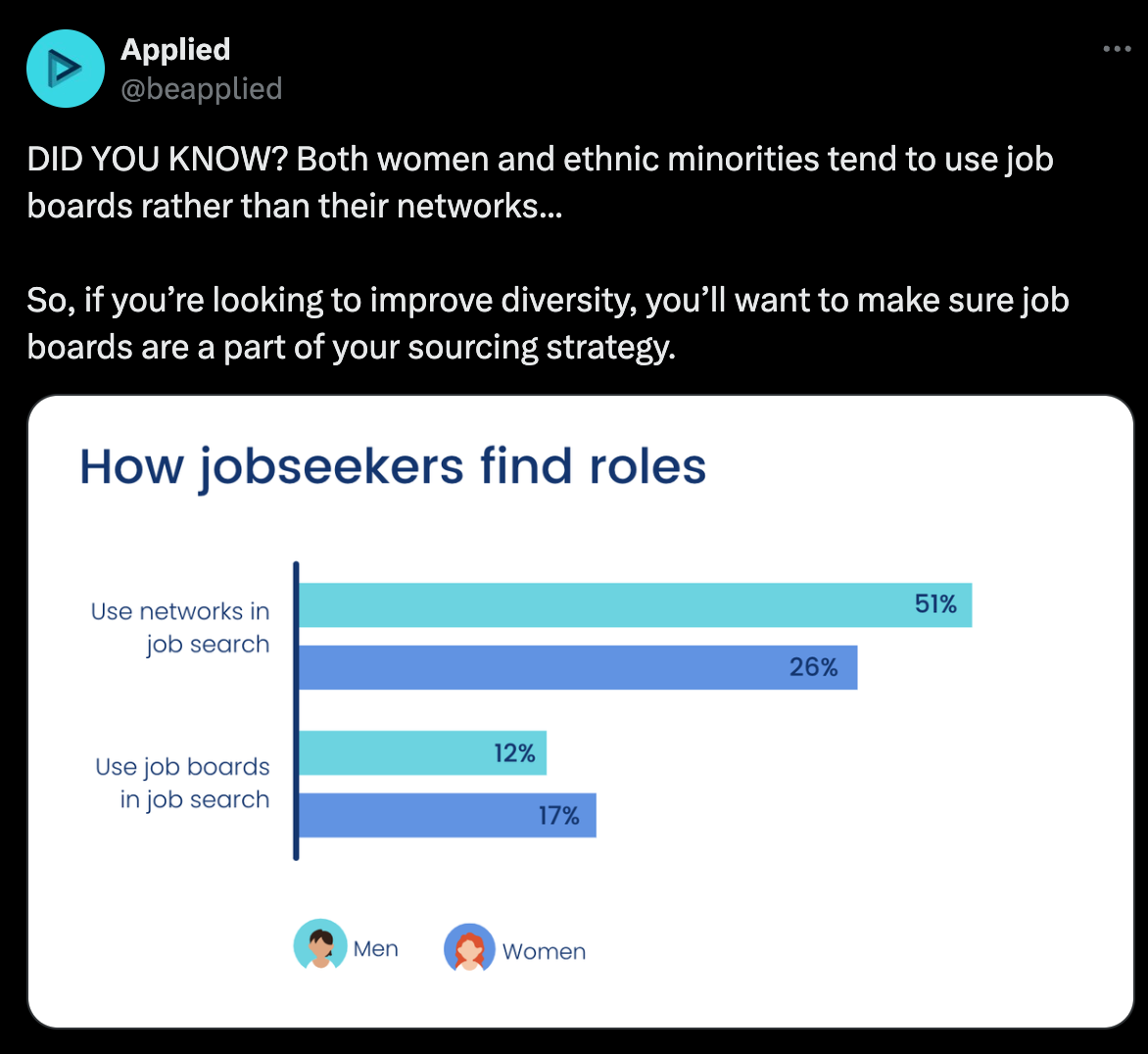
“You can have the best job ad in the world, but if it's not reaching the right people then it makes it redundant!
For example, youth empowerment organisation 2020 Change has just launched a talent arm to help companies find young Black talent.
The Return Hub helps diverse talent (mainly women) return to financial services jobs after career breaks.” - Emily Horton
More accessible job listing options
Alongside job boards for marginalised groups, you could give the vacancy details to your local Jobcentre Plus.
You could also list the vacancy on accessible websites that work with screen magnification and screen reading software, such as Guardian Jobs or Monster.
Note: accessible websites sometimes (but not always) display the W3C or RNIB's Surf Right logos.
Could you hire internally?
When hiring for a new role, try not to get tunnel vision about external candidates.
Try not to forget about the people already in your org.
Women are 55% more likely to not know about internal job openings.
Women from “underrepresented backgrounds” are three times less likely to be formally identified as “high potential.”
Women are 55% more likely to not be aware of internal job openings.
Even if people are aware of a job opening, they might not consider themselves for the role because:
they think another employee is already favoured
they don’t feel supported in applying for internal roles - 17% of employees feel their manager facilitates the process of applying for internal job openings
they think it’d be awkward, potentially hinting at dissatisfaction
they think it’d be easier to grow in their career elsewhere.
Stick to your deadline
Listing a deadline for applications is a great idea.
Share the closing date, but avoid saying, “We might close when we get enough applicants.”
This isn’t a Lucky Dip. And it’s wrong.
It seriously disadvantages carers, working parents, shift workers, and so on, who can't apply right now but plan to do so later.
Section 4 checklist

5. Your workplace culture
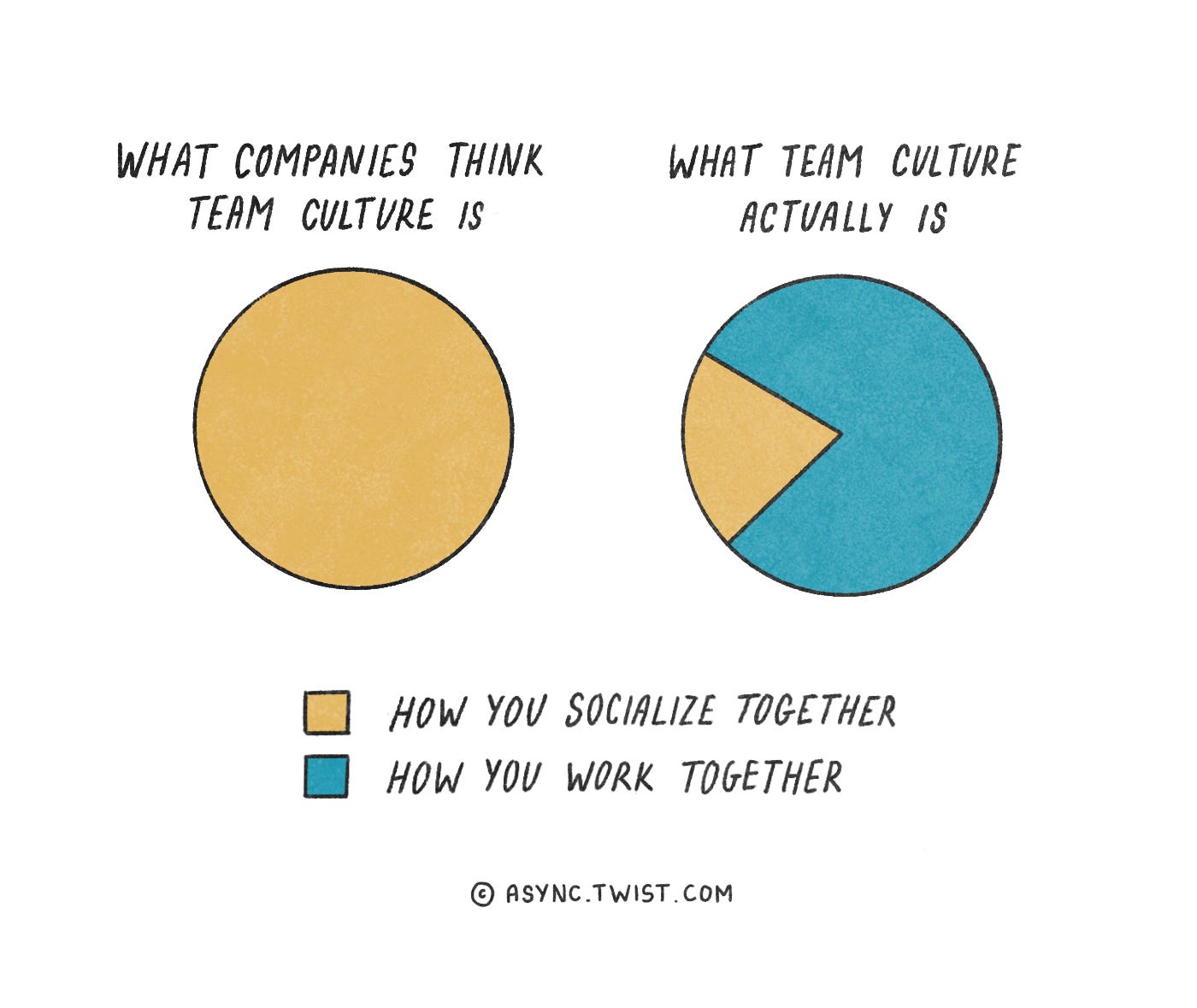
Let’s briefly settle what workplace culture is, by clarifying what it certainly isn’t.
Your culture isn’t contained in “perks” like:
“Beer-o-clock”
Beer isn’t a substitute for a healthy working culture. Do you have a model of socialising and community that includes people who don’t drink alcohol?
Fun freebies
Job adverts that parade freebies may be mistaking them for culture.
Just so we’re on the same page: ping-pong tables, a prosecco tap in the office, a nap pod - these things don’t count as culture.
“Unlimited” leave
Be careful with the phrasing here. You might allow people to take leave as and when they need it, rather than having a set number of bookable days.
But that doesn’t mean it’s unlimited. It’s highly limited by social norms.
(Senior staff can often take a lot of annual leave, while junior staff take zero days.)
Talking about “minimum leave” may be more useful. For instance, Buffer switched from offering unlimited leave to “strongly encourag[ing]” folks to take a minimum of 15 work days off per year.
Tell an authentic story
Your brand’s story is the blueprint for your culture.
It needs to be authentic, and it needs to tell us who you are. So, be honest and try to cover:
What do you stand for?
How do you approach the major issues in your sector?
How do you nurture creativity?
What is genuinely unique about your organisation, and how are you defending it?
Let people see themselves in your org
Show diversity.
No, not that (one) photo of your two Asian employees looking uncomfortable. Show the actual breadth of your team.
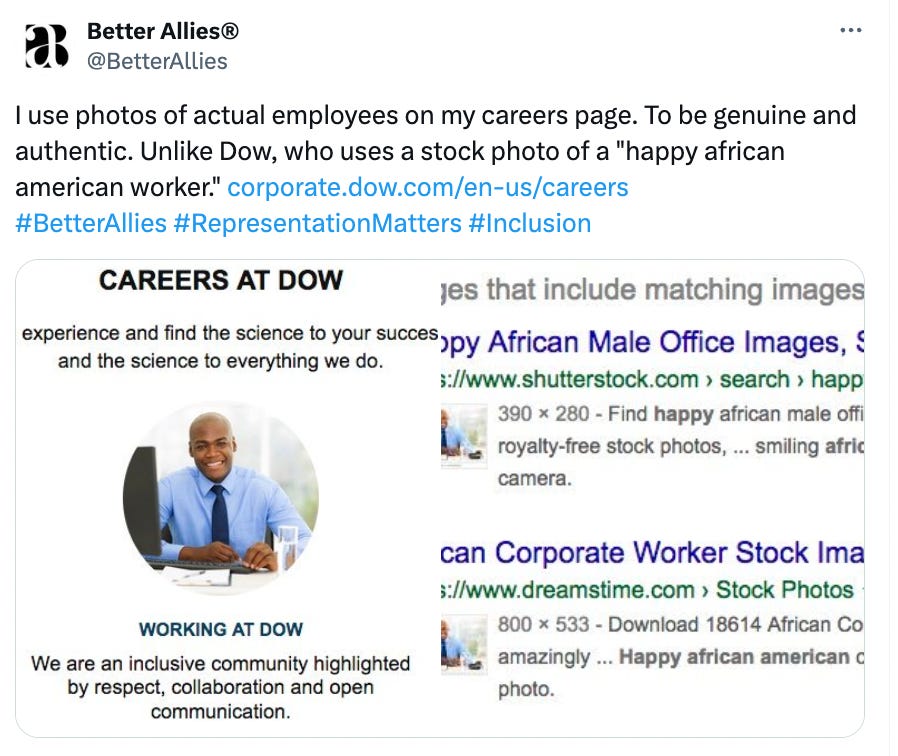
It may not be visible; diversity can include lots of invisible features, like neurodivergence, chronic illnesses, class, and so on.
“Please don’t use stock photography on your careers page to represent your employee base. It may be a tempting solution, but candidates can easily do an image search online and find that your “employee” is a model who appears on many job sites.” - Karen Carlin
Have a plan, not a promise
Do you have a meaningful strategy for becoming more equitable, diverse and inclusive? Or do you have some nice-sounding statements?
If you have a policy and a plan of action, put that out front.
Inclusive job adverts:
describe what the known issues are,
acknowledge plainly where you are,
outline credible plans to address those issues.
Inclusive companies then:
do the work,
make sure not to reward the exact behaviours you need to get rid of,
embed a willingness to make mistakes, learn from them and keep going.
Say what you want. Be aspirational. Activate hope.
Talk about workplace wellbeing
Wellbeing isn’t a few life hacks like having an external keyboard and a proper lunch break.
A model of wellbeing should explain how staff can:
keep their humanity,
feel well,
be a part of your organisation’s mission.
The Mix does a fantastic job of showing the full lives their staff lead outside of work, by showing what people do with their Fridays. (Side note: how great does their four-day week look?)
Important reminder: policies don’t need to be dry. Take Frida’s Happiness manifesto, for example.
It uses “I will” statements to showcase commitment and connection.
There are playful ones too (“I will think outside the dropbox”).
And ones that call for personal responsibility: |I will communicate when I overtire myself”, plus collective commitments: “we will be free on Fridays and only work Monday to Thursday”.
It includes spaces for team members to write their own.
It’s broad where it needs to be and tailored where that helps.
And it’s beautiful.
Don’t claim allyship
If you slap a flag or badge on your website during some causes, why not others?
Of course, our solidarity for Ukraine should be deep and heartfelt. But where is the solidarity for the many other conflicts?
“Are you uplifting the community by donating to charities that support them? Or is the profit going to your shareholders?
Are you paying Queer creators to make goods for Queer folk? Or have you just rebranded some stuff that still only exists in ‘men’s’ and ‘women’s’ sizes?
Are you using influence to lobby against these horrendous bills? Or are you just interviewing your employees for your Instagram feed?” - Jamie June Hill
Why now? What support are you giving? When do you remove your support?
Do you put an LGTBQ flag up during June and then take it down? When are you not supporting?
If you do show allyship for a passing cultural moment, tailor it to your authentic values.
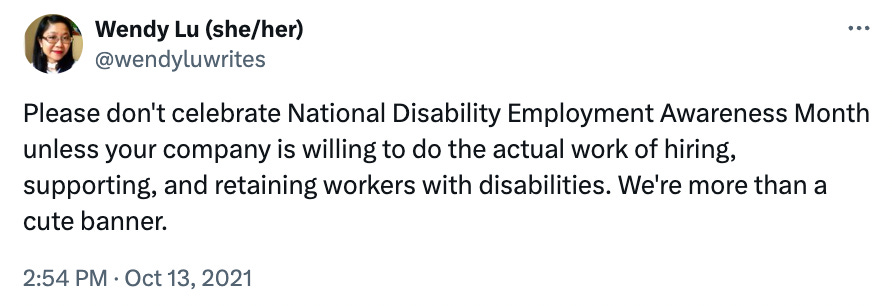
But if your values are actually central to what you do, then celebrate that. Other Things do this really well, by putting their values of purpose front and centre.
Note: if you have groups for employees, mention them.
Steer clear of hiring for “culture fit”
If you want to obliterate your equity, diversity and inclusion goals, hire for “culture fit.”
Why? It’ll attract more people just like you.
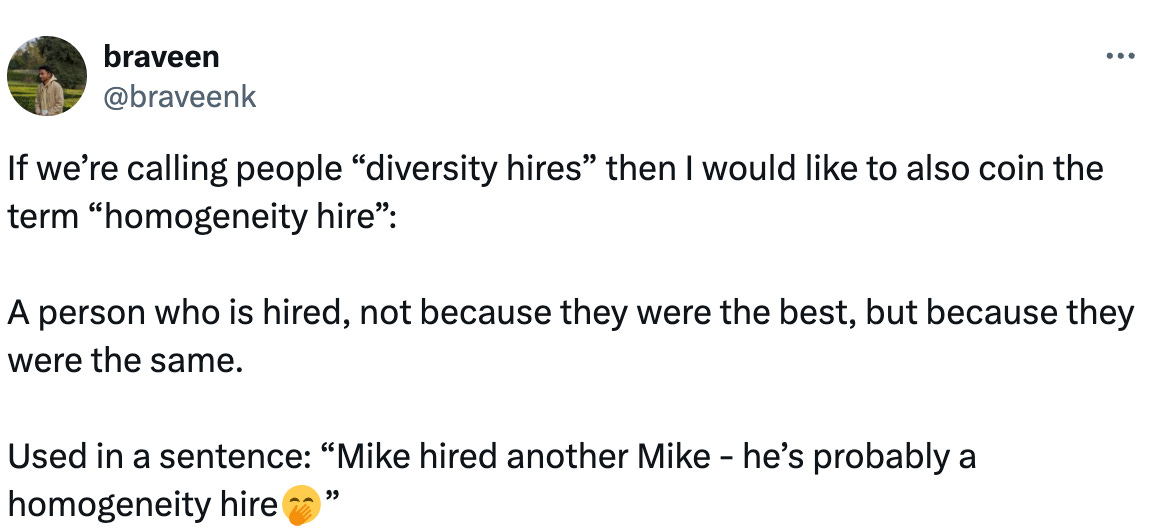
Instead, hire for cultural enhancement.
Valory puts it well:
“We hire up, out and within. Up – folks who are better than us in some important dimension. Out – folks who add diversity on as many axes as possible to the team. Within – folks who share our passion for multi-agent systems, crypto and building world-changing technology.”
Avoid the “business case for diversity”
“We're not just quotas to be filled, or frills to add spark; real inclusivity is wanting the whole of each person, and what they bring.” - Ann Storr
Sometimes, diversity is packaged up as a sweet little capitalist gift.
One that’ll “boost your bottom line”, “skyrocket productivity”, “enhance innovation”, and so on.
But this sinking ship is submerged in performativity and profit.
Diversity is packaged up as a sweet little capitalist gift. One that’ll “boost your bottom line”, “skyrocket productivity”, “enhance innovation”, and so on. But this sinking ship is submerged in performativity and profit.
This sinking ship is otherwise known as the “business case for diversity”. And it’s something we need to be careful of when talking about ED&I initiatives.
Don’t hire neurodivergent people because you think they have super skills.
Yes, working parents are highly efficient. But don’t hire them for that reason.
“Obtaining any lasting benefit from diversity requires not just the presence of a diverse workforce but also effective leadership that can manage conflict, create cultures of inclusiveness characterized by psychological safety and growth mindsets, and make organizational change where needed to support a diverse workforce.
In other words, the business case for diversity only appears after hard work to transform its many costs into benefits, hard work that few companies are actually willing to do.” - Lily Zheng
Section 5 checklist

6. Application process
The syllabus for job applications typically looks something like:
submitting an application form, CV and cover letter,
completing online tests about our skills/hypothetical scenarios,
having a virtual interview,
having an in-person interview,
having another interview with more/different people.
Is this the most accessible and inclusive way to hire someone? I’m not convinced.
Could we shorten the process, making it easier/more efficient for everyone involved? Absolutely.
No CVs
Collaborative Future has a no CVs, no cover letters policy.
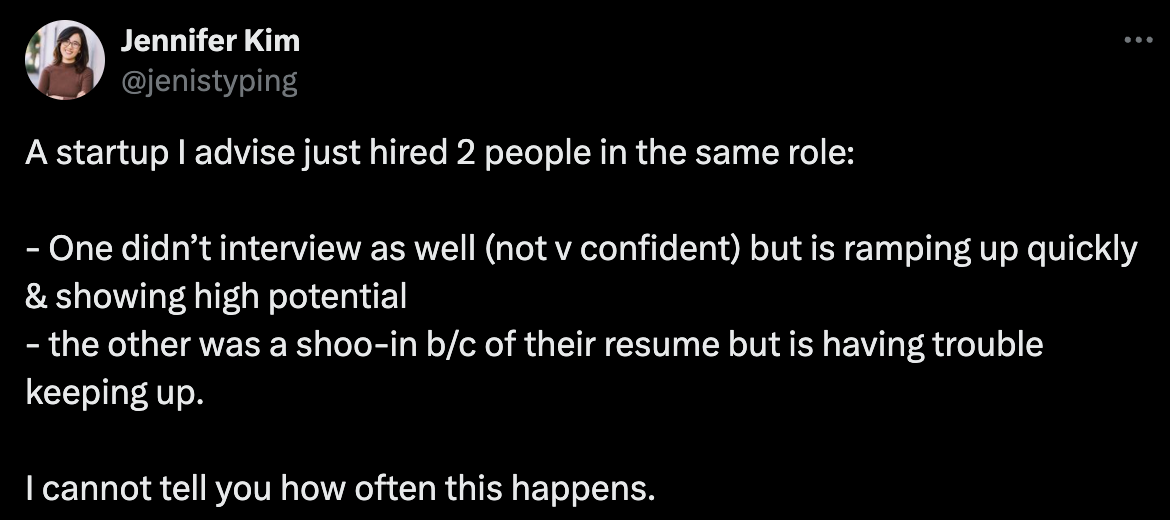
Why? CVs are simple for some people to put together, and incredibly difficult for others. (A lot of younger people I work with have never created a CV!)
Plus, they’re a brilliant way to maintain bias around who can do certain jobs.
Offer a range of options
Accessible application processes offer a variety of options.
For example, you might accept:
written applications,
video recordings,
audio recordings.
“We created a new application process specifically for our new role […] including a simple online application and a request for a 3-minute video.
We didn’t ask for a CV or a written statement and based our selection procedures on attitude, ideas and each candidate’s responses […].” - Emmy Minton.
Change how you assess candidates
Sorry to break it to you:
Asking someone how good they are at something is not an accurate way to test how skilled they are.
Change who you reach, and how you assess them. Rethink what “good” looks like.
Perhaps you could even offer people an informal chat about the role before they apply.
Asking someone how good they are at something is not an accurate way to test how skilled they are.
To assess candidates fairly, you could:
ask for work samples
ask them to do a task*
do a role-play scenario
evaluate their skills using an evidence-based metric, scoring every candidate so you can compare fairly.
*If you’re setting up a task, pay people for their time. Likewise, don’t give people impromptu tasks (on the spot).
“52% of people with dyslexia have experienced discrimination during interview or selection processes.
Given that 10% of the population has dyslexia, that’s a lot of job seekers.” - Katy Alexander
Keep it short
Don’t make applying for your job a full-time job.
Complex job applications are an unnecessary barrier that can disproportionately affect people who:
have caring responsibilities
have health conditions to manage
are Disabled/neurodivergent
are trying to live a full life.
Keep the application as short and simple as possible.
Don’t gather any data that you won’t/can’t use to inform your choices (apart from diversity monitoring).
Give some tips on how to fill in the application. This helps people who haven’t applied for many roles before or don’t have a network of people who can help them.
Don’t make applying for your job a full-time job.
Allow disclosure
Make it safe for people to disclose their support needs, for instance, if they’re Disabled/neurodivergent.
Don’t force people to disclose, though. Only 39% of Disabled people tell their employers about their disability.8
And remember: self-diagnosis is absolutely valid.
“Coming out” as neurodivergent at work won’t be safe or desirable for everybody.
Women are often underdiagnosed; neurodivergence shows up very differently depending on gender and other factors.
Diagnosis isn’t equal for/available to everyone.9
“One way to proactively support people with hidden disabilities is to make DE&I a company priority. In particular, I’m talking about a specific kind of DE&I that allows for what I call “diversity with dignity.”
This is a form of DE&I that reduces the need for employees to even disclose hidden disabilities because quality, inclusive measures are in place and available to the whole workforce.” - Marcelle Ciampi
Avoid using AI
AI screening is widespread. As many as 75% of (US) employers rely on it.
It supposedly simplifies the hiring process, but it can be deeply problematic because:
AI learns from datasets.
Datasets of successful candidates will over-represent white, wealthy, cisgender men.
So it often picks up historical biases.
An Amazon tool, for example, discriminated against women for this reason.
It can be deeply ableist, too.
For example, some employers use video interviewing software that measures a person’s speech patterns or facial expressions.
This could screen out people with speech impediments, arthritis (that slows typing), and a whole host of other disabilities/conditions.
If you use AI, explain how it works
Be concrete and specific.
Most candidates will benefit from clear instructions like:
“The machine screener will look for specific keywords and context, so avoid language not in the job description and person specification.”
“If possible, submit a Word document. It is easier for automated screeners to identify keywords.”
“If you submit a PDF it must be the type of PDF where you can highlight the text. If not, the software won’t find keywords and you will be automatically rejected.”
“Use a plain word format with bold titles, and simple solid black bullet points. Don’t have headers/footers, tables, columns, boxes, complex graphics, images, colours, or special characters.”
To interview or not to interview?
Most of us assume interviews are necessary. (It’s what we’ve always done, right?)
Next time you’re hiring, ask yourself, “Is an interview the best way to assess the skills I’m looking for?”
If it is, that’s fine. Just make sure you hire for job competence, not for interview confidence.
For example, some candidates - particularly neurodivergent/Disabled folk - are penalised for things like:
sounding robotic or rehearsed,
seeming too anxious,
not having a firm handshake.
These aren’t the job requirements. I’ll say it again: hire for job competence, not for interview confidence.
Unless the job requires face-to-face communication (like front-of-house hospitality), you may be selecting candidates for skills that aren’t relevant to the job.
Hire for job competence, not for interview confidence.
Section 6 checklist

7. The interview
Inviting someone for a (virtual or face-to-face) interview?
Interviews are anxiety-inducing for most of us. So, here are six simple tips to give everyone the best chance of performing at their best.
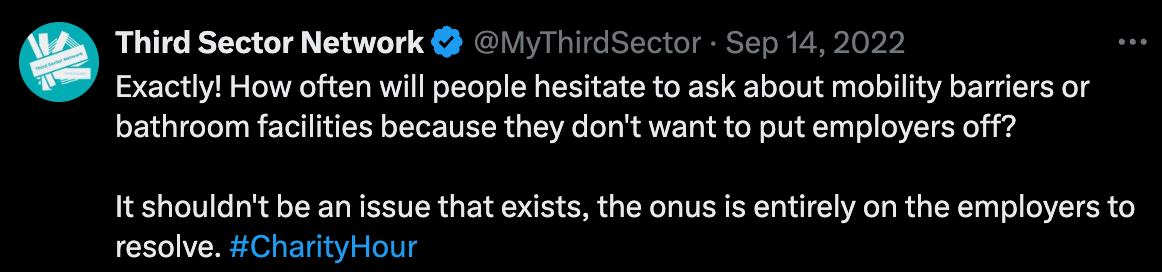
Describe the set-up
Give the candidate plenty of time to (mentally) prepare for the interview.
An easy way to eliminate pre-interview nerves is to let people know what to expect.
Who? “There will be a Zoom call with these two managers. Here are their bios.”
How long? “The call will take up to 45 minutes. We will take a 5-minute break half way through.”
What? “We will start by asking some questions about your employment history, and then we’ll ask you about your skills. There’ll be time at the end for you to ask us questions, too!”
Where? “Here is a map to help you find our office. It’s a 5-minute walk from bus stop A.”
Sensory information: “There will be some fluorescent lighting in the office, but the interview room will be set to softer, dimmer lighting.”
Wheelchair access information: “There is level access into the interview room.”
Share interview questions in advance
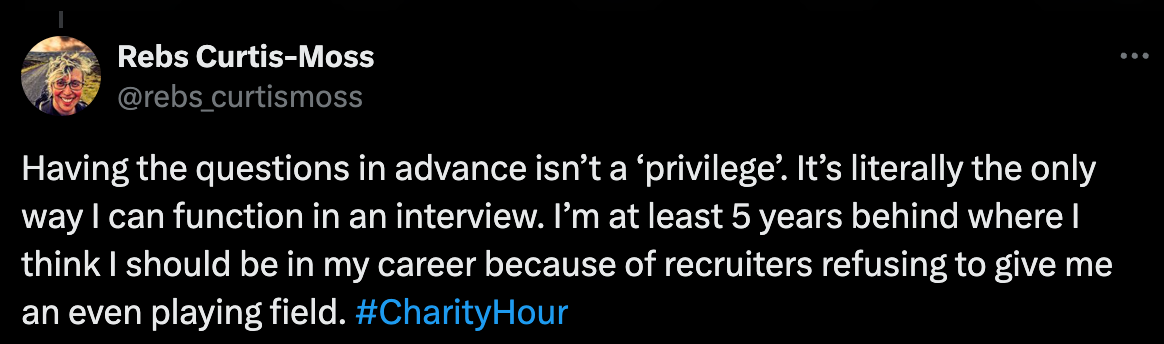
Yes, you read that right. Give interview questions in advance, in writing.
Just like describing the set-up, sharing questions in advance helps to avoid unnecessary anxiety.
Particularly for neurodivergent people, Disabled people, shy people, people who like to plan, anxious people, busy people, those who like to research/prepare a lot, folks who struggle with last-minute changes, and so on.
It’ll help everyone be less nervous and more authentic.
“Having ADHD makes me extremely stressed out in interviews, practising endless ‘STAR’ answers for weeks until I had anxiety attacks.” - Leanne Maskell
Applicants for John Lewis and Waitrose roles can now see the questions they’ll be asked before the interview.
Why? Talent Head, Lorna Bullett said that:
nerves can affect the interview performance of neurodivergent people,
it gives them the best chance of finding the right person for the role,
it allows people to better prepare for interviews.
Ask for reverse questions
Reverse questions allow candidates to judge if the role is suitable for them, too.
Examples include:
How do you measure success in this role?
Can you tell me more about the company culture, and how you prioritise inclusion?
What is the onboarding process like?
How does the company approach work-life balance?
How would you describe the leadership style of the company's executives?
At Scope, applicants are asked for reverse questions around a week before the interview.
They’re also asked:
the phonetic pronunciation of their name
their preferred name (if it’s different to their legal name)
their pronouns if they’d like to share them
any specific accessibility needs.
Ask a variety of question types
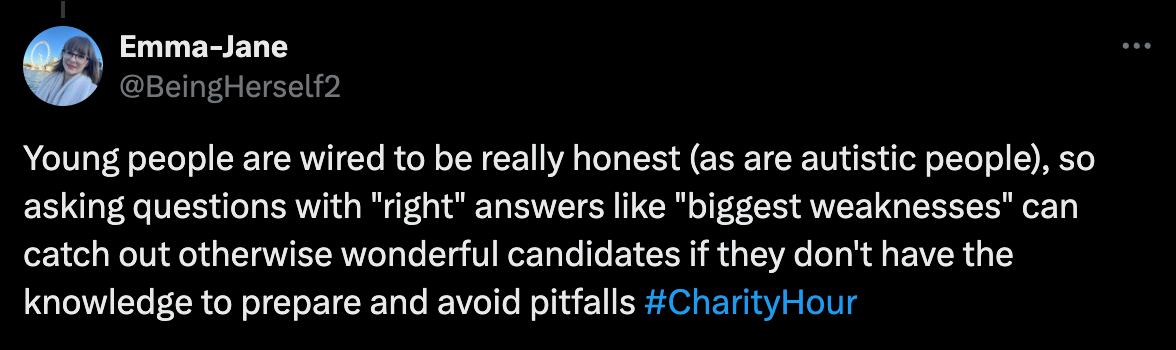
For a fair assessment, balance the types of questions you ask.
You could mix it up between:
personal questions like, “What professional achievement are you most proud of? Why?”
competency-based questions like, “Describe a situation in which you led a team”
technical questions like, “How would you change this piece of code that’s running slowly?”
performance-based questions like, “Have you had to juggle several important projects under tight time constraints in the past? If so, did you organise your work?”
“Balance competency-based approaches with strengths-based assessment and situational judgement testing as they have fewer negative effects on under-represented groups and are linked to job performance.” - Gov.uk
Offer varied adjustments
Don’t just ask about your applicant’s accessibility needs (although do that, too).
Some people might not know what type of adjustments they need. So, you could list some!
There are countless ways to design processes and spaces that are disability and neurodivergent-friendly. As always, be specific.
A “trial run” for online interviews
Some candidates might not feel confident in using online platforms. Could you offer a "trial run" to all applicants?
This is an easy way to avoid problems on the interview day.
Phone-based interviews
You could offer an interview over the phone for those who find video platforms difficult to use.
Office space adjustments
Your office needs to accommodate different accessibility needs - not just for interviewees!
Adjustments could include:
soundproofing
flexible layouts (a mix of desks facing people/walls)
clocks that don’t tick out loud
blackout blinds
sit-stand desks
light diffusers
wobble stools
wide access paths
multiple screens
support for body doubling
dimmable lighting
the freedom to work remotely.
Plus, I think we’d all appreciate:
smell awareness (no food in bins, no strong perfume)
walls that aren’t painted bright white
noise-cancelling headphones being normalised
casual or highly flexible dress codes.
Of course, you can’t list every type of reasonable adjustment. But try including a few examples that might be relevant to your workplace, either in the job advert or via email to applicants.
Cover costs
Offer to reimburse applicants who incur travel costs to attend an interview.
An interview reimbursement policy should include:
Simple guidelines on eligible expenses (travel, accommodation, and so on)
A clear process for reimbursement claims
Defined limits
Specific exclusions
On top of travel costs, you could consider reimbursing childcare costs too.
Section 7 checklist

Diverse hiring isn’t the solution
It’s the result.
When you tweak your workplace culture to be more inclusive and accessible, you’ll start recruiting the diverse hires you want.
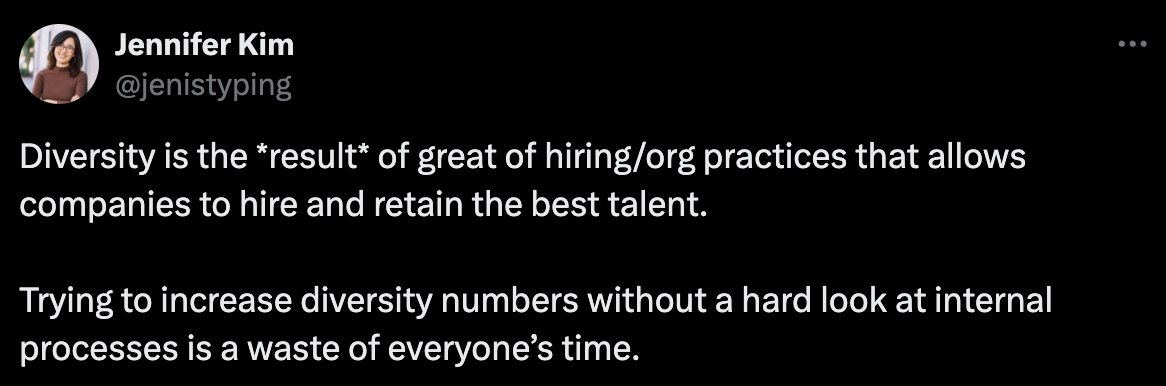
If you make your organisation look more equitable than it is, you’re encouraging minoritised people to enter a space they won’t be safe.
You have to actually change.
Brands to learn from
If you’d like some inspiration for brands that do inclusive and accessible hiring well, here’s a list of the organisations I mention in this article:
Ready to take your learning further?
I’ve condensed years of learning about inclusive and accessible communication into one joyful (12-week) course.
Get the knowledge, confidence and support you need to become a fearless communicator.
I don’t mean to attack those whose job title is Brand Evangelist or Happiness Hero. If it’s meaningful and relevant for your sector, and your work is given the resources and respect it deserves, then I’m not talking about you!
The research only mentions “men” and “women” so we can’t be certain, but non-binary and gender non-conforming people may also be put off by masculine-coded language.
And remember: if you have to mention genders, say “all genders” not “both genders”. There are more than two.
Feel free to play this as a game of Red Flag Bingo.
This name has been changed so the speaker can remain anonymous.
Where it says “trans-gender status” I think it should say “gender” or “gender identity”.
I lied. PDF actually stands for Portable Document Format.
These statistics don’t account for those who have a non-apparent condition they don’t choose to call a “disability.” For example, an individual with dyslexia may consider their dyslexia a “condition” rather than a “disability.”
NHS waiting lists for autism/ADHD assessments are several years long in the UK, and private assessments can cost thousands of pounds. Oh, and even filling out the forms takes a level of executive function that a lot of us just don’t have!
This is great, Ettie! Smashed it 🔥