Hi friends,
You may have heard about the Barbie movie.
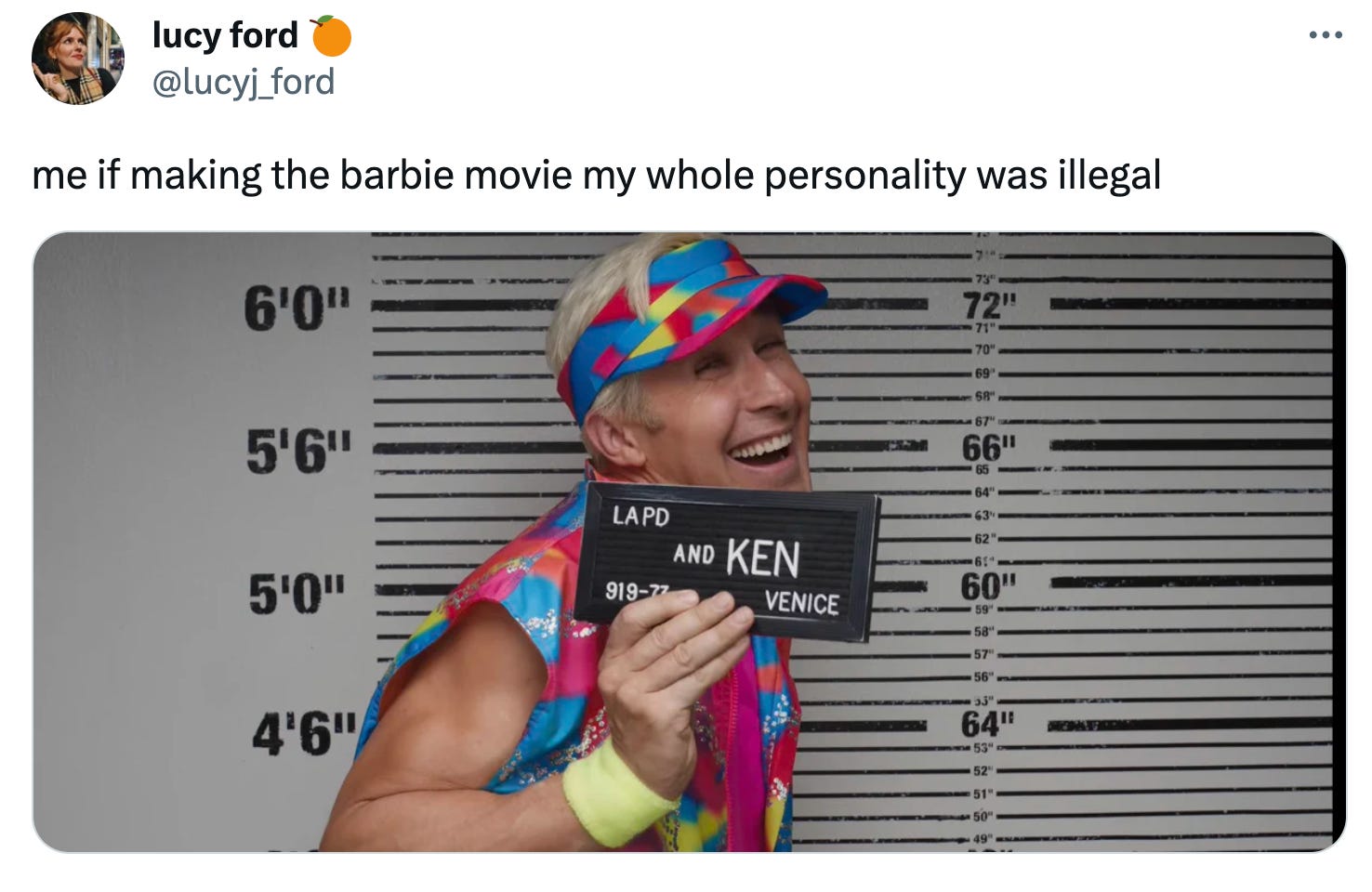
I went to see it, and now I communicate entirely in Barbie memes.

Ruth Bader Ginsburg dreamed of an all-woman Supreme Court. Well in Barbieland, that’s a reality.
And the president is a Black woman. Oh, and when physicist Barbie accepts her Nobel prize, she says: ‘I’ve worked hard for this and I deserve it.”

In Barbieland, Barbies are defined by their traits and achievements. They’re individuals.
Ken is just Ken, because his trait is being male and decorative.
It’s kind of like Smurfette in the Smurfs. All the male Smurfs have traits like being Brainy, Handy or Hefty. Smurfette is just… female.
What male default means
As legendary feminist linguist Debbie Cameron writes:
“In our culture being male is the ‘default’ gender and being female is ‘marked.’ Women are defined by their gender, but men aren't. Or, to put it another way, "Men are people; women are women."
“[Default maleness] appears in countless contexts” writes Amanda Montell in Wordslut. “But among them is the pervasive assumption that many esteemed professions — surgeons, scientists, lawyers, writers, actors — are perceived male unless proven otherwise.”
For example:
We say “female doctor” or “woman scientist.”
We don’t say “male president” or “man pilot.”
When I was 9 I told an older person I wanted to grow up to become an author. She corrected me to “authoress.” (It could just as easily have been usherette, comedienne etc). I’m not there yet, but perhaps I’m now a Substack-ess?
Girlbossification
Mompreneur. She-E-O. Girlboss. Excuse me, I need to go vomit.
Even seemingly celebratory terms can be sexist.
Girlboss looks empowering, at a distance. “But what it actually does” writes Amanda Montell “Is reinforce the notion that the word "boss" is not actually gender-neutral, but has default male implications. "Girlboss" may read as a glittering emblem of feminine power, and certainly makes for a zingy hashtag, yet in practice it doesn't quite work to undo gender divides — it enhances them.”
“While ‘girl boss’ immediately draws attention to the feminine, it also infantilises the role of a female as a boss. Have we ever heard about ‘boy bosses?’” asks Magdalena Zawisza-Riley.
“The use of either woman or female with terms such as ‘president, speaker, doctor, professor’ suggests that a woman holding that position is marked — in some way unnatural” explains linguist Robin Lakoff.1 “Every time we say ‘woman president’, we reinforce the view that only a man can be commander in chief, symbolize the U.S. (which is metonymically Uncle Sam and not Aunt Samantha, after all), and make it harder to conceive of, and hence vote for, a woman in that role.”
Words, images and stories shape what we can imagine.
In this video by Inspire The Future, kids were asked to draw a firefighter, pilot and surgeon. They drew men.
When the surgeon, fire fighter and pilot walk in, the kids’ faces light up with surprise and delight. The surgeon, fire fighter and pilot are women.
The world is built for men
We live in a world built for men.
Please immediately go and buy a copy of Invisible Women by Caroline Criado Pérez, if you haven’t read it already.
Here are just a few of the things that are mainly researched, designed or delivered for men (all from Caroline’s book):
Language didn’t cause gender bias.
But it helps to make it look normal and natural.
Male default language
Until recently, it was common to:
Use grammatically masculine terms to talk about everyone.
Say mankind instead of humankind. That matters because we actually do understand mankind to be masculine. We don’t say “mankind has made huge advances in his search for better makeup” (or something else mainly associated with women).
This helps shape how we see the world.
We tend to assume that an unmarked person is male. Or even, as Debbie Cameron wonderfully explains, a cartoon dog.
Research by Scott Kiesling finds that when we hear “I met this person the other day”, most people picture a cisgender white man.
Okay, that’s enough about the problem. How do we change it?
How to disrupt sexism in language
In a sexist world, even gender neutral language can end up perpetuating sexism.
Don’t mark gender if you don’t need to
It’s good not to assume – or mark – gender if you really don’t need to.
Genuinely talking about all genders? Then say that, or use standard words like “people”, “they”, “you” and “everyone.”
Use gender neutral terms consistently
Gender neutral words like “flight attendant” (instead of air stewardess) or “chair” (instead of chairman) often get re-coded as feminine.
If you call businessmen businessmen, but then say “business person” only when you’re talking about women, you’ve once again marked them out as remarkable.
Use the same word for everyone.
Consider the context
Gender neutral language matters. But it does no good unless you are using it to say and do things that will create gender equity.
I could use perfectly good inclusive language, like saying “women and marginalised genders.” Then I could argue that gender diversity doesn’t matter on boards, and that actually diversity of thought is what counts. Er… no.
Care most about impact
Psycholinguistic studies find that feminised suffixes like -ette and -ess generally have negative, or at least diminutive, connotations.
You might think that means avoiding them. But I disagree.
Organisations like STEMettes are doing incredible work, supporting women and girls to break through gender bias in fields like engineering and maths. They’re helping create a world where we don’t have to say “woman scientist.”
That is a thousand times more feminist than saying “actually, you mustn’t say comedienne.”
So think about impact. Is it actually useful or relevant to say “female chef”? A lot of the time, it’s not.
But sometimes, marking gender will help to create solidarity, inspiration or support for women and marginalised genders. So go ahead and mark gender.
Use your words to guide actions
If you’re not actually tackling sexism (or racism, ableism, etc) then I’d honestly rather you didn’t switch up your language to look more inclusive. That would just be glittering the turd.
OK Barbies, that’s it!
What did you think? Reply to this email, or drop me a message on LinkedIn, Twitter or Instagram and let me know.
If you need me, I’ll be taking a tour of the Barbie dream house.
Quoting from an excruciating 2007 article by William Safire. We’ll cover the difference between woman and female in a future newsletter.


So good - am really glad you addressed how sometimes it IS useful to mark gender. I didn’t think about that nuance til recently - always wanting to use gender neutral language. But I have a pal who self identifies as an actress (a term I’d never use as it doesn’t sit well with me) and we ended up having a great conversation about it. For her, there is a serious fiscal difference for AFAB people who are acting and an important SW-pos history associated with it - so actress for her is a piece of activism
"Substack-ess" the way I CACKLED.