

Don't get sued (even Beyoncé can be sued for inaccessibility)
Don't get sued, my dude

Bold Type is back! My 12-week course in inclusive and accessible communication kicks off on Tuesday 23 September.
And because I want you all to sign up for Bold Type, I’m spending the next few weeks talking about what we’ll learn and why it matters.
Like how inclusive and accessible communication can:
stop you from getting sued (yes, really)
save you money,
protect your team’s time and energy
reach more customers
boost your reputation
invest in staff wellbeing and culture
improve profitability (from time efficiency)
hire and retain the right staff (helping you attract the best candidates, harness their talent, and be the kind of place people want to work).
Before I get into why…
A reminder: this email is also available as an audio recording.
Hit “play” to play my voiceover version.
Accessibility compliance can save you money
So you already know that accessible content is a non-negotiable.
But did you know that accessibility can save you money, too?1
Bold Types are often stunned when we get to week 3, and start learning about digital accessibility.
If your emails, social media, web content (and more) aren’t accessible, you’re at risk of:
excluding disabled, neurodivergent, tired and distracted people,
missing out on support and engagement from the 1 in 4 of us in the UK who are disabled,
hurting the estimated 4.3 million disabled online shoppers who click away from inaccessible websites, according to the Purple Pound. That’s an estimated combined spending power of £11.75 billion in the UK.
Families of disabled people are estimated to spend £274 billion in the UK, £13 trillion globally. Every single year.
And that’s before we consider laws and directives like the:
Accessibility laws exist
“Wait, there are accessibility laws (and directives like the EAA)… that apply to my content, and I could get sued under them?”
“If my US-based website isn’t WCAG compliant, I could be fined?”
“So if I use an assistive toolbar (which I now know are yuck) that can violate GDPR?Why did no one tell me this before?!”
Most of us never got told about the EAA, GDPR or ADA.
Here’s why you need to know about them.
Even big brands are getting this wrong
You would think that Beyoncé or Taylor Swift’s teams would have so many resources, they couldn’t possibly get accessibility wrong.
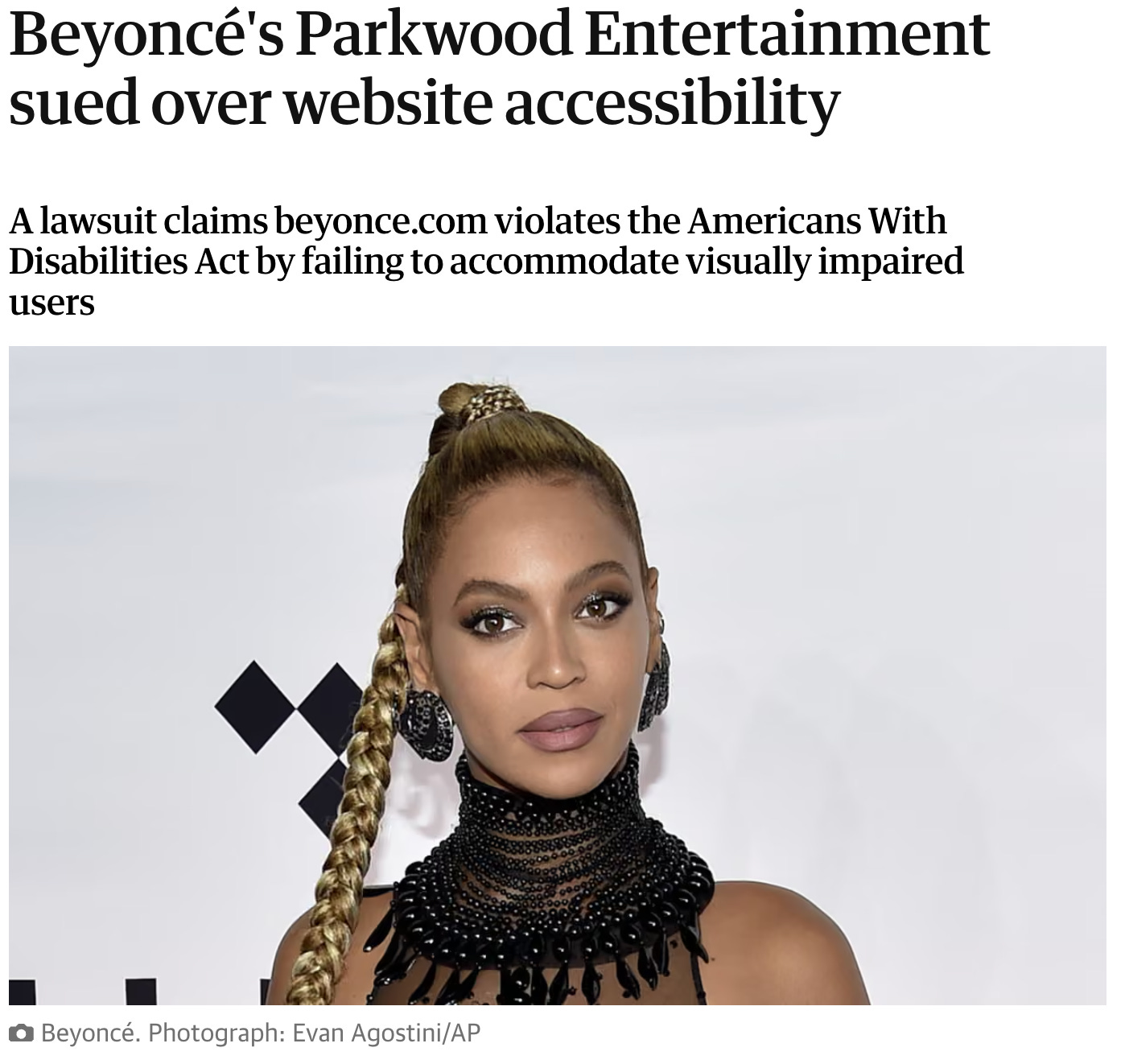
But even Beyoncé has been sued for website inaccessibility!
As the Guardian says:
“A class action lawsuit claims that Beyoncé’s official website violates the Americans With Disabilities Act (1990) by denying visually impaired users equal access to its products and services, according to the Hollywood Reporter.”
And oh dear lord, Taylor Swift’s Life of a Showgirl website is just… an accessibility lawsuit waiting to happen.
You could get fined
ADA violations can result in damages ranging from thousands to millions of dollars, plus mandatory remediation costs and ongoing compliance monitoring.
The EAA introduces fines that can reach up to 4% of annual global revenue.
In 2023, over 4,000 digital accessibility lawsuits were filed in US federal courts. That’s a 400% increase from just 5 years earlier.
The end of 2024 saw 8,800 ADA title III complaints filed.
I’m no statistician, but those numbers are going up. Fast.
These lawsuits span every sector.
Some companies have paid settlements from $50,000 to over $13 million. plus costs to fix the problems (website remediation), ongoing auditing and staff training.
That adds up to some gigantic costs. More than the settlement amount!
GDPR hates your overlay (and so do I)
Adding an accessibility overlay or widget to your website can seem appealing.
I really get it! They say they make your website more accessible. (It’s ‘cos they’re lying).
There’s a one word answer to the question “should I use an accessibility overlay?”
And that answer is: no.
Users can already modify things like text or cursor size, for free, without unwanted side effects.
You don’t need an expensive or AI-powered solution to do that.
As well as causing countless problems for users of assistive technology, toolbars can violate privacy laws like GDPR, UK GDPR, and CCPA.
You won’t be fined at the highest level possible under GDPR, for having an overlay.
So you won’t face the current maximum fines of €20 million or 4% of global annual turnover.
But you could still be fined for violating privacy under laws like GDPR.
And lose a whole lot of time, energy and - if you’re a worrier, like me- sleep.
The European Accessibility Act (EAA)
EAA compliance isn't a "nice-to-have.”
It’s compulsory, no way around it.
Doesn't matter if you’re based in Silicon Valley or Singapore. If you serve EU customers, you're in.
The EAA applies to you…
if you sell products or services to people in the EU,
even if you’re based outside the EU.
There is an exception for micro-enterprises (fewer than 10 people and under €2 million in revenue).
But you could still be affected by the directive, even if you’re a micro-enterprise.
Let’s say you sell e-books through an online vendor. Big vendors are affected, so you’ll need to comply with the EAA to be able to keep selling your e-books.
Penalties for EAA non-compliance
Fines can hit €250,000.
That's 250,000 great reasons to invest in accessibility.
According to ReciteMe, fines could potentially2 look like:
Non-compliance fines
€5,000 to €20,000 per violation
E-commerce site missing alt text? €10,000 hit
Transport app with broken keyboard nav? That could be a €15,000 fine, thanks.
ReciteMe estimates web accessibility fails could attract fines of €50,000, and missing accessibility statements could attract further penalties.
Daily penalties
Up to €1,000. Every single day!
Startup website with navigation issues? You could see fines of €30,000 in just 30 days.
The Americans with Disabilities Act (ADA)
Across the pond, the Americans with Disabilities Act applies to all areas of public life.
If you run a business3 your website is considered a “place of public accommodation.”4
That means your website needs to be WCAG compliant.
If it’s not, you could be sued.
And you’ll almost certainly be excluding current and potential customers.
Honestly, I’m not really one for laws, rules and penalties as the solutions to problems.
I believe in positive reinforcement and celebrating hard work, not telling people off or shaming them). Carrot, not stick.
I think we need:
crystal clear guidelines,
support and celebration for our hard work,
and a safe space to test, fail and learn from it.
But I won’t lie.
Part of me is glad to see some seriously big numbers flying around here!
I really hope it will mean leaders invest the money, time and energy that accessibility deserves.
If you’re looking for a safe and welcoming space to learn about inclusive language and accessibility, I’d love you to join us on Bold Type.
See you there?
Listen, I’m no fan of the “business case for accessibility.” Profit isn’t why we care about accessibility. Justice is. But we should all know about the laws that affect us, the penalties we could face.And if that helps encourage some employers to invest in accessibility? I’m all for it.
I haven’t seen enough evidence for this that I’m confident saying it will happen. I’m citing ReciteMe, who may be wrong.
With a few exceptions. If you have fewer than 15 staff members, open for less than 20 weeks a year or run a religious organisation, you’re probably ADA exempt.
Since 1996, websites have clearly been understood as public places. But there is possible precedent, as of December 2024, for online-only businesses to not be considered public places. Read more about this Southern district of New York ruling.